What Is AIoT — and Why Every Indian Maker Should Care
The convergence of AI and IoT is reshaping how devices are built. Here's what it means for hobbyists and product teams in India.
AIoT — Artificial Intelligence of Things — is what you get when you take connected sensors and actuators (IoT) and add on-device or cloud AI inference. The device doesn't just collect and transmit data anymore; it understands it.
For most of the IoT era, 'smart devices' meant: sensor reads value, microcontroller decides threshold, if value > threshold then trigger relay. That logic is simple, reliable, and perfectly adequate for a lot of use cases. But it breaks down the moment the real world stops behaving as cleanly as your threshold assumed.
What makes it 'AI' and not just 'smart'
The distinction matters. A thermostat with a temperature threshold is not AI. A thermostat that learns your schedule, predicts when you'll be home, and adjusts proactively — that's AI. The difference is not just in capability; it's in how the logic is created. Threshold logic is written by a programmer. AI logic is learned from data.
In an AIoT device, the AI component might run in the cloud (the data goes up, inference comes down), at the edge (a model runs directly on a capable microcontroller or SBC), or in a hybrid — preprocessing at the edge, deeper inference in the cloud.
Edge AI vs cloud AI in IoT
- Cloud AI: lower hardware cost, unlimited compute, but requires connectivity and has latency
- Edge AI: works offline, low latency, privacy-preserving, but constrained by the hardware
- Hybrid: preprocess and filter at the edge, send only relevant events to the cloud for deeper analysis
For Indian deployments especially, edge AI is often more practical. Connectivity in tier-2 cities and rural areas is improving but not yet reliable enough to base a product on always-on cloud inference. A device that can do meaningful processing locally — and sync when connectivity is available — is far more robust.
Why this matters for Indian makers and product teams
India has a large and growing maker and electronics community. The country also has a specific set of problems — agricultural monitoring, supply chain quality control, health sensing in low-connectivity environments — that AIoT is well-positioned to address. Not with imported solutions from Silicon Valley, but with locally built hardware designed for local conditions.
The components are increasingly accessible. ESP32-S3 and similar SoCs now have enough RAM and processing power to run TensorFlow Lite models for audio classification, vibration analysis, or image recognition at low power. The tooling — TFLite Micro, Edge Impulse, Arduino IDE integrations — has matured significantly.
"The most interesting AIoT projects in India are not consumer gadgets. They're industrial monitoring, agricultural sensors, and healthcare diagnostics — problems where local conditions make imported solutions a poor fit."
A practical AIoT project for makers: vibration-based anomaly detection
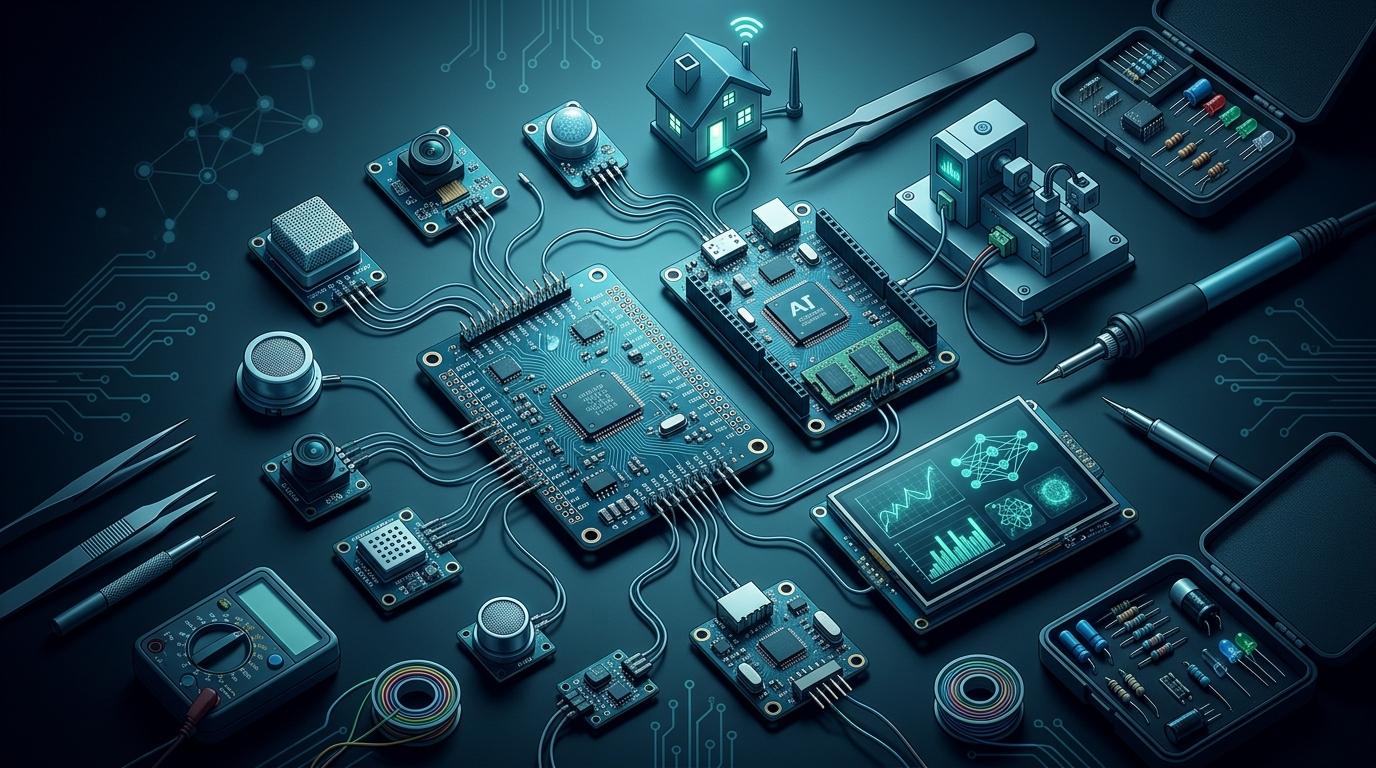
Here's a concrete example of an AIoT project a maker in India can realistically build today. A small device attached to a motor or pump that learns what 'normal' vibration looks and sounds like, and alerts when something deviates — predicting a bearing failure before it happens.
The hardware: an ESP32-S3 (available for about ₹400), an MPU-6050 accelerometer (about ₹60), a small LiPo battery, and a case. Total hardware cost under ₹800.
- Collect vibration data from the motor in normal operation for a few hours
- Train a simple anomaly detection model using Edge Impulse (free for makers)
- Deploy the model to the ESP32-S3 as a TFLite Micro binary
- The device now classifies each vibration window as 'normal' or 'anomalous' locally
- On anomaly, send an alert via MQTT or WhatsApp API — no cloud AI call needed
This is AIoT. The AI part (the anomaly detection model) runs on the device, at the edge, without connectivity. It was trained in the cloud, but inference happens locally. The device is genuinely intelligent about what it's sensing.
What RoboDIB's AIO V1 is designed for
The RoboDIB AIO V1 controller is built with AIoT applications in mind. The combination of ExpressLRS connectivity, 615 coreless motor support, and a high-speed flight processing brain is not just for drones — it's a platform for AIoT-enabled robotics where the device needs to make fast, intelligent decisions locally.
As the AIoT ecosystem in India matures, the gap between 'prototype on a breadboard' and 'deployable product' is narrowing. The tools, the hardware, and the community are all in place. What remains is building things.
Build your first AIoT project with RoboDIB hardware
The RoboDIB AIO V1 is an AIoT-ready robotics platform designed for Indian makers. ExpressLRS, high-speed processing, and a fully repairable design.
More from the blog
RoboDIB
Solve these problems yourself
AI inventory, component map, 3D printing, and circuit design tools — all built for India's maker community.