Building an AIoT Home Automation System in India — What the Tutorials Don't Tell You
The basics work. Production-grade reliability requires a different level of thinking.
The beginner home automation tutorial is always the same: get an ESP8266, connect to WiFi, turn an LED on and off from your phone. Works great. Feels like magic. Then you scale it up and the magic reveals itself as held together with cable ties and optimism.
My first system had eight nodes controlling lights and fans. It worked most of the time, which meant it failed often enough to be unreliable. The second was better but still had phantom disconnects and occasional state desync. The third — built after I understood what the first two taught me — runs 97 days between interventions by my own measurement.
The Reliability Problem in Indian Homes
Indian residential environments are harder on electronics than most tutorials assume. Power fluctuations and short outages are common — your devices need to handle graceful recovery from power loss, not just the sunny-day WiFi connection case. Humidity in coastal cities causes corrosion on exposed connections. Power cuts create surge events on restoration.
None of these are insurmountable. All of them need to be designed for, not discovered after deployment.
- Design for power outage recovery: devices should reconnect and restore last state automatically
- Use TVS diodes or MOV varistors on power supplies in surge-prone areas
- Conformal coat PCBs for high-humidity environments (coastal cities, monsoon season)
- Store state in non-volatile memory so it survives power cycles
- Implement watchdog timers — if the main loop hangs, the device reboots
The Protocol Stack Question
WiFi is convenient but battery-inefficient and sometimes unreliable for devices that need guaranteed delivery. For a light switch that you're messing with twenty times a day, WiFi is fine. For a sensor that wakes up every 15 minutes to report temperature, WiFi's connection overhead burns battery fast.
For battery-powered sensors, consider ESP-NOW (peer-to-peer ESP WiFi without a router), Zigbee (with a hub), or LoRa for longer range. For mains-powered devices, WiFi with MQTT over a local broker is reliable and well-supported.
The protocol you use depends on the power source. WiFi for mains power, low-power protocols for battery. This one decision solves most battery life problems.
Local vs Cloud Intelligence
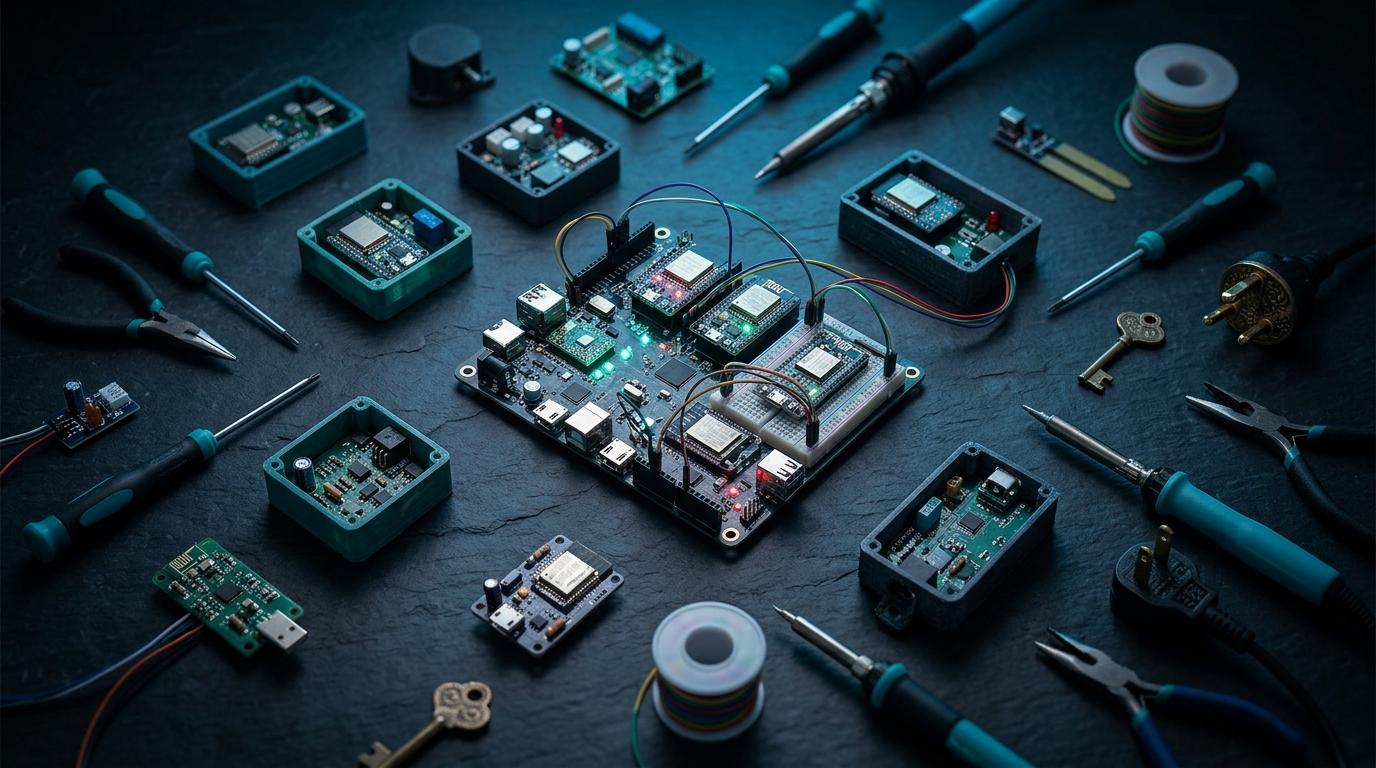
Early home automation systems relied on cloud for everything — every command routed through AWS or Google's servers. This created dependency on internet uptime and introduced latency. Modern systems push intelligence to the edge: the decision to turn on the light when motion is detected runs locally, with cloud sync for remote access and analytics.
For Indian deployments specifically, local-first is important because internet reliability varies. A system that fails when the ISP has a hiccup is much less reliable than one that runs autonomously locally and syncs when connected.
The AI Layer
Once you have reliable sensor data from a working system, the AI layer becomes interesting. Pattern recognition on occupancy data, anomaly detection on power consumption, predictive control based on time and context. This is the AIoT promise — not just remote control, but intelligent adaptation.
Start with the reliable local system. Add the intelligence layer after the foundation is solid. It's tempting to start with the AI feature. The engineers who do this spend most of their time debugging reliability problems while the intelligence layer sits unused.
Build smarter with AIoT
RoboDIB's AIoT modules are designed for Indian conditions — tested for heat, humidity, and power fluctuations common in India.
More from the blog
RoboDIB
Solve these problems yourself
AI inventory, component map, 3D printing, and circuit design tools — all built for India's maker community.