How AIoT Is Changing Inventory Management for Indian Electronics Labs
Real-time component tracking, low-stock alerts, and AI-powered reorder predictions — what AIoT means for the electronics workbench
Inventory management in electronics labs — whether a professional R&D lab or a well-stocked home workbench — has traditionally been a manual problem. You count components, you log them in a spreadsheet, you try to keep the spreadsheet current. It's tedious and it always falls behind reality.
AIoT changes the equation. Not by making the spreadsheet digital — that's been possible for decades — but by making the data collection automatic, the analysis intelligent, and the insights actionable in real time.
What AIoT-powered inventory looks like in practice
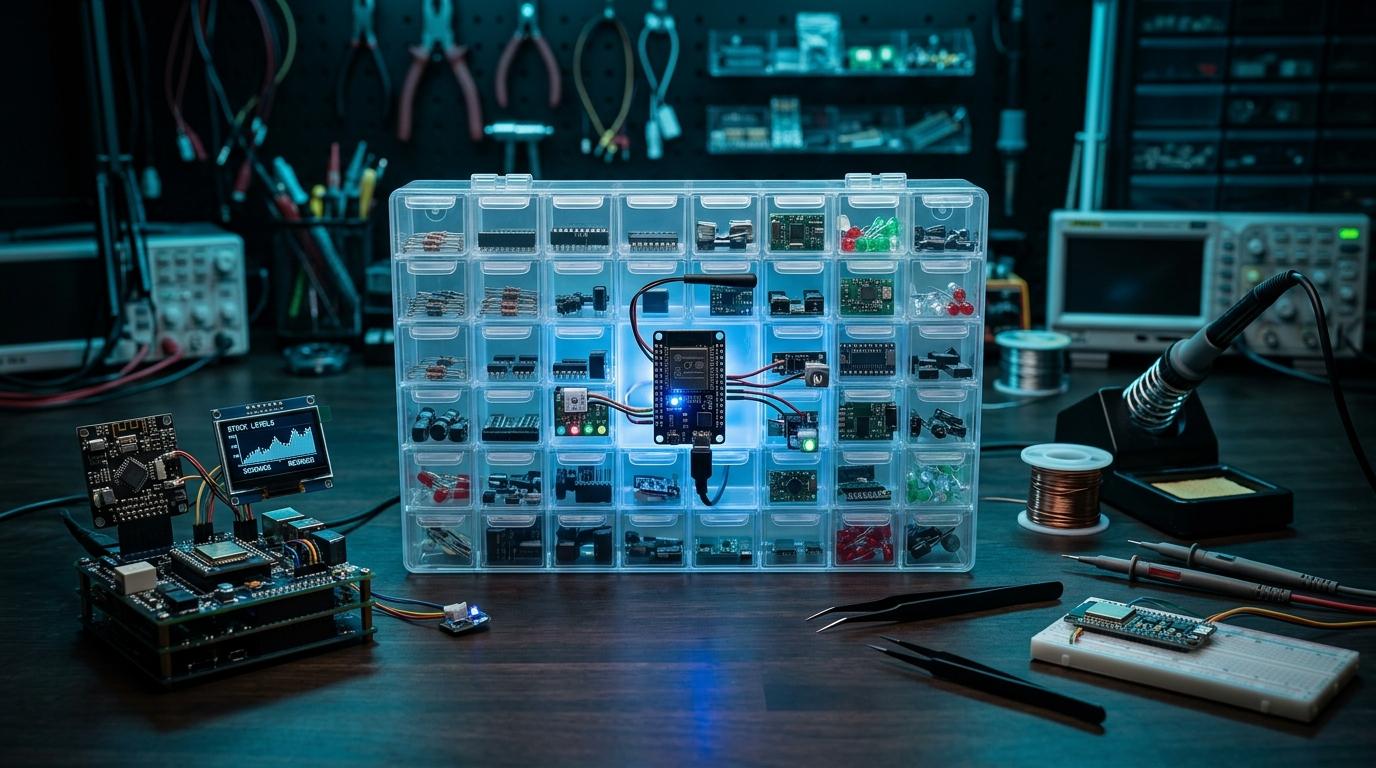
At the basic level, AIoT inventory means connected sensors tracking what comes in and what goes out. A barcode scanner at the component storage area, a weight sensor on the resistor drawer, RFID tags on module trays. Each interaction is logged automatically — no manual entry required.
The AI part is what makes it more than just an automated logbook. Machine learning can identify patterns: which components you use together on projects, which ones consistently run low before you reorder, which purchases were duplicates you probably didn't need. Over time, the system builds a model of your usage patterns.
Specific AIoT applications for the maker bench
- Automatic quantity tracking via weight sensors — know your resistor stock without counting
- Usage pattern analysis — predict which components you'll need for your next project
- Low-stock alerts with smart reorder suggestions before you run out
- AI-powered BOM parsing — paste a bill of materials and have it matched to your inventory automatically
- Duplicate order detection — flag when you're about to order something you already have
The AI inventory approach: smarter than search
The most immediately useful AIoT application for most makers isn't full sensor integration — it's intelligent software that makes the data you do enter work harder. AI-powered inventory that can parse a freeform list of components, understand synonyms ('NPN transistor' matches your BC547 stock), and surface insights from your usage history.
This is what RoboDIB's AI Inventory is built around. You paste a BOM, a supplier invoice, a WhatsApp message listing parts — the AI parses it, identifies the components, matches them to your existing inventory where possible, and presents you with a structured entry to confirm. The manual work is minimal; the AI handles the interpretation.
"AI inventory that understands 'I need a pull-up resistor around 10K' and tells you that you have 47 of them in shelf B, position 3 — that's the AIoT future for makers."
Why this matters more in India
Supply chain lead times from major Indian suppliers have improved significantly, but they're still not same-day for most components. Knowing that you're running low on a critical component before you start a project — rather than discovering it at 11 PM the night before a deadline — changes everything about how you plan.
For college labs and institutional workshops, AIoT inventory has even more impact. Components go missing, get used without logging, accumulate in student project boxes. A system that can track stock across multiple users, flag unusual depletion patterns, and identify when components need reordering — that reduces the chronic frustration of 'who used all the capacitors' that every lab technician knows.
Getting started: the pragmatic path
You don't need to deploy hardware sensors to get started with AIoT-style inventory management. The intelligence layer — AI parsing, pattern recognition, predictive alerts — can work from manually-entered data while you're getting started. As your dataset grows, the predictions get better.
Start with the AI parsing: stop manually entering components one field at a time and start pasting your supplier invoices and BOMs. Let the AI do the interpretation work. Then, as you build confidence in the system, you can consider adding sensor layers — a simple RFID reader at the component shelf, a barcode scanner on the desk.
The path from 'shoebox of unlabelled components' to 'AIoT-powered lab inventory' is iterative. But every step makes the next project easier.
Start with AI-powered inventory today
RoboDIB's AI Inventory parses your BOMs and invoices automatically, tracks your component stock, and tells you what you're running low on — before it becomes a problem.
More from the blog
RoboDIB
Solve these problems yourself
AI inventory, component map, 3D printing, and circuit design tools — all built for India's maker community.