Why I Spent 3 Hours Looking for a 10K Resistor That Was Right There
The component hunt that every maker knows too well — and why it keeps happening
It was 11 PM, deadline the next morning, and I was on my knees digging through a shoebox of unlabelled component bags looking for a single 10K resistor. I had maybe forty of them. Somewhere.
Three shoeboxes, two plastic organisers, and one very chaotic zip-lock collection later — I gave up and soldered a 4.7K in its place and hoped the pull-up would still work. It didn't. Spent another hour debugging what I thought was a firmware issue before I realised the resistor was wrong.
Sound familiar? If you're a maker, a hobbyist, or an electronics student in India, it almost certainly does.
The real problem isn't buying components. It's knowing what you have.
We're pretty good at ordering. Robu.in, Electronicscomp, Amazon — add to cart, checkout, done. Components arrive, we use what we need for the current project, and the rest goes into the drawer. Or the shoebox. Or the corner of the shelf that we keep meaning to sort out.
Nobody teaches you how to manage a component collection. Engineering college definitely doesn't. The electronics lab has a storekeeper for that. But at home, on your own workbench — you're on your own.
"I have three multimeters because I kept forgetting I had one and buying another whenever a project needed it." — a conversation at a Bangalore maker meetup, 2024
This is more common than people admit. The thing about components is that they're small, they all look the same, and the consequences of not finding one right now are usually just 'I'll order another'. Which you do. And now you have two. And then three.
What happens when you can't find something
There are really only a few outcomes when you're mid-project and can't locate a component:
- You order a new one. Minimum 2-3 day wait. Project halts.
- You substitute something and hope it works. Sometimes it does. Often it creates a bug you spend the next day tracking down.
- You give up for the night and lose momentum. The project sits half-done for two weeks.
- You actually find it — at 1:30 AM, after emptying every container you own onto the floor.
None of these are good outcomes. And all of them happen because of the same root cause: you don't have a fast, reliable answer to the question 'do I have this, and where is it?'
The organisation methods people try (and why they mostly don't work)
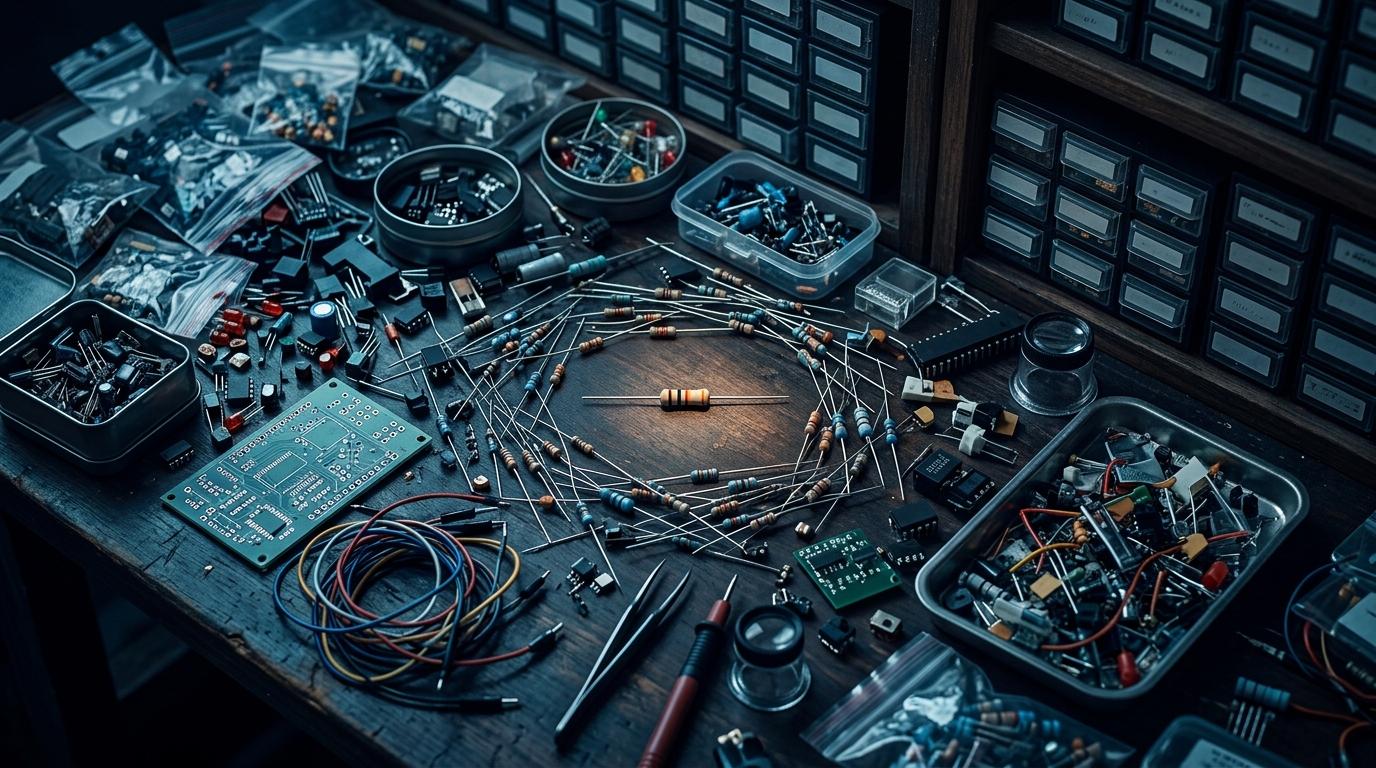
Most of us go through a few stages of trying to fix this. The component organiser box with labelled compartments is the most common first attempt. And it works great — for maybe three weeks, until you're in a hurry and just drop something in the nearest compartment, and the system quietly breaks down.
Then there's the spreadsheet phase. Column for name, column for quantity, column for location. It takes a solid afternoon to set up. You update it religiously for a month. Then you use three capacitors and forget to update the count, and now the spreadsheet is wrong and you can't trust it, so you stop using it.
The problem with manual systems
All of these approaches share the same flaw: they require you to maintain them. Every time you use a component, you need to update the record. Every time you buy something new, it needs to be logged. When you're deep in a project and you just want to grab the part and get back to work — the last thing you want to do is open a spreadsheet and decrement a counter.
So the system degrades. And then you're back to the shoebox.
RoboDIB's AI Inventory is built for exactly this problem
Paste a bill of materials, a supplier invoice, or just a freeform list — it parses automatically. Search by description, not just part number. Know what you have, where it is, and what you're running low on.
What actually helps
The only thing that has actually made a consistent difference for me — and for most of the makers I've spoken to — is having a system that's fast enough to update that you'll actually do it, and smart enough to fill in the gaps when you don't.
Concretely: if I can paste a bill of materials, a WhatsApp forward from a supplier, or even just a freeform list into something and have it parse automatically — I'll actually do it. If I have to manually enter fifteen fields for each component, I won't.
The other thing that matters is being able to search by description, not just exact part names. Searching for 'NPN transistor for switching' should find your BC547s and your 2N2222s. That kind of semantic search is what makes an inventory system actually useful in the middle of a project.
A different way to think about it
Your component collection is actually an asset. You've spent real money on it — probably more than you realise. If you totalled up every component purchase over the last two years, the number would likely surprise you. That value is just sitting there, partially accessible, partially unknown.
An inventory that tells you what you have, what you're running low on, and what the total value of your collection is — that's not just convenient. It changes how you shop. You stop impulse-buying things you might already have. You know exactly when to reorder before you run out rather than after.
And the next time it's 11 PM and you need a 10K resistor — you search, you see 'Shelf B, compartment 3', and you're back at your workbench in two minutes. That's worth sorting out.
More from the blog
RoboDIB
Solve these problems yourself
AI inventory, component map, 3D printing, and circuit design tools — all built for India's maker community.