I've Ordered ESP32s Four Times. I Had Six at Home.
How makers end up buying duplicates — and the quiet cost that adds up over time
There's a particular kind of frustration that hits when you're unpacking a courier and you find the exact same component sitting right there on your bench. You ordered it three days ago because you were sure you'd run out. You hadn't.
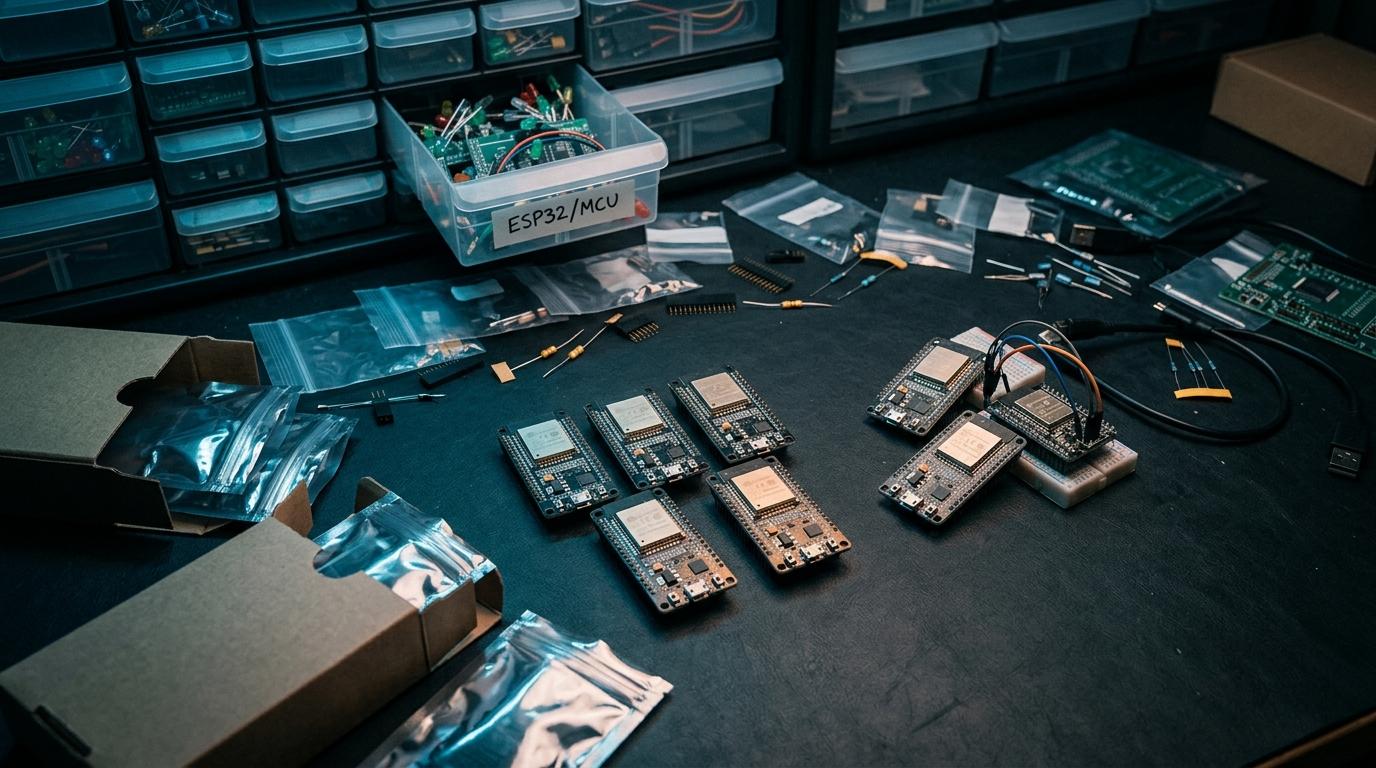
I've done this with ESP32 dev boards four times over two years. Each time I started a new wireless project, I'd check my bench, not find one immediately, and order. By the time it arrived, I'd have found one — or two — in a different drawer. I currently have six. I need maybe two at a time.
This is not an organisational failure. It's a visibility problem.
I know how to be organised. I have neat shelves. I have labelled boxes. The issue is that my component collection has grown organically over years of projects, and the mental model I have of what I own is always a few purchases behind reality.
When you buy something for a specific project, you use the project context as the memory cue — 'I got those hall effect sensors for the motor controller thing'. When the project is done and the remaining components go into storage, that context disappears. The component is now just a small unlabelled bag in a drawer, and your brain has no reliable way to retrieve it when you need it for something else.
The average well-stocked hobbyist workbench in India holds somewhere between ₹8,000 and ₹25,000 in components. Most people have no idea what's actually there.
The problem compounds over time
In the early days of a maker hobby, when your collection is small, you can keep track. Twenty types of resistors, a few capacitors, a handful of ICs — you know roughly what's there. But collections don't stay small.
Every project adds components. Every 'assortment pack' purchase adds fifty items at once. Every time you buy a module to test it and it goes into the maybe-useful-later pile. After two or three years of active building, even a casual hobbyist can have several hundred distinct component types. No human memory can reliably track that.
The hidden cost of duplicates
Each duplicate purchase might be just ₹50 or ₹200 individually. But across a year of active making, it adds up. More importantly, it adds friction. There's the time waiting for a delivery you didn't need to make. There's the time spent on the order. And there's the mental overhead of the original 'do I have this?' uncertainty, which slows you down every time it comes up.
Stop ordering what you already own
RoboDIB's AI Inventory gives you a real-time view of your component collection. Before placing your next order, just search — and know for certain.
What good visibility looks like
The test of a good inventory system is simple: before placing an order, you search for what you need and get a reliable answer in under thirty seconds. Not 'let me check the drawer' — an actual searchable record.
- What exactly do I have, by name and part number
- How many are available right now
- Where physically are they stored
- When did I last buy them and from whom
With that available, you stop ordering duplicates. You also start noticing patterns — 'I always run out of 100nF ceramics, I should keep more stock' — that make you a more efficient builder.
The add-as-you-go approach that actually works
The biggest barrier to maintaining an inventory is the effort of adding things to it. If you have to manually enter a new item every time you receive a delivery, it feels like admin work, and you'll stop doing it.
The approach that works better is bulk input — take your invoice or BOM, paste it in, let the system parse it and suggest the entries. Fix what's wrong, confirm, done. Three minutes for a whole courier instead of fifteen minutes of manual entry.
Do that consistently for a month or two and you'll have a collection record that's actually reliable. And the next time you're about to order those ESP32s — you'll know you already have six.
More from the blog
RoboDIB
Solve these problems yourself
AI inventory, component map, 3D printing, and circuit design tools — all built for India's maker community.