Every Engineering College Lab Has a Cupboard Full of Components Nobody Uses
The inventory that isn't doing anything — and the students who need it across town
Third-year project season. You need 4 HC-SR04 ultrasonic sensors right now. The lab has a cupboard with maybe thirty of them. But the lab is in a different department, the storekeeper needs a requisition form, the form needs a faculty signature, and the faculty member is in a meeting until 4 PM.
So you go to SP Road instead. Two hours round trip. ₹400 spent. The college had them the whole time.
This is not an unusual situation. It's the standard situation. And it doesn't just happen at the institutional level — it happens between students in the same hostel, between labs in the same department, between maker spaces that are three kilometres apart.
The access problem isn't the components — it's the visibility
Nobody intentionally hoards components. Labs accumulate them over years of projects, donations, and bulk purchases that turned out to be too much. Individual makers buy in minimum order quantities and use a fraction. The surplus is real — it's just invisible to the people who need it.
The fundamental issue is that there's no map. No way to say 'who near me has HC-SR04 sensors available right now'. The answer might be a fellow student, a lab next door, or a maker three streets away — but without visibility, you default to the distributor.
Why this matters more than just convenience
The obvious cost is time and money. But there's a less obvious cost: the components that never get used at all.
Labs get upgraded. Projects get cancelled. Batches expire or get superseded. Components that were bought for a specific purpose sit in a cupboard for three years and then get thrown out — or more often, stay in the cupboard indefinitely because nobody wants to deal with disposal.
- ESP8266 modules from 2019, still in original packaging, taking up space.
- L298N motor drivers bought for a project that went a different direction.
- Raspberry Pi peripherals from a batch that got replaced by newer hardware.
- Sensor kits from lab exercises that ran once and were never repeated.
"We cleared out a storeroom last semester. Found components worth at least ₹15,000 that had never been used. Most of it ended up in a bin." — lab instructor, Bangalore engineering college
The maker-to-maker alternative
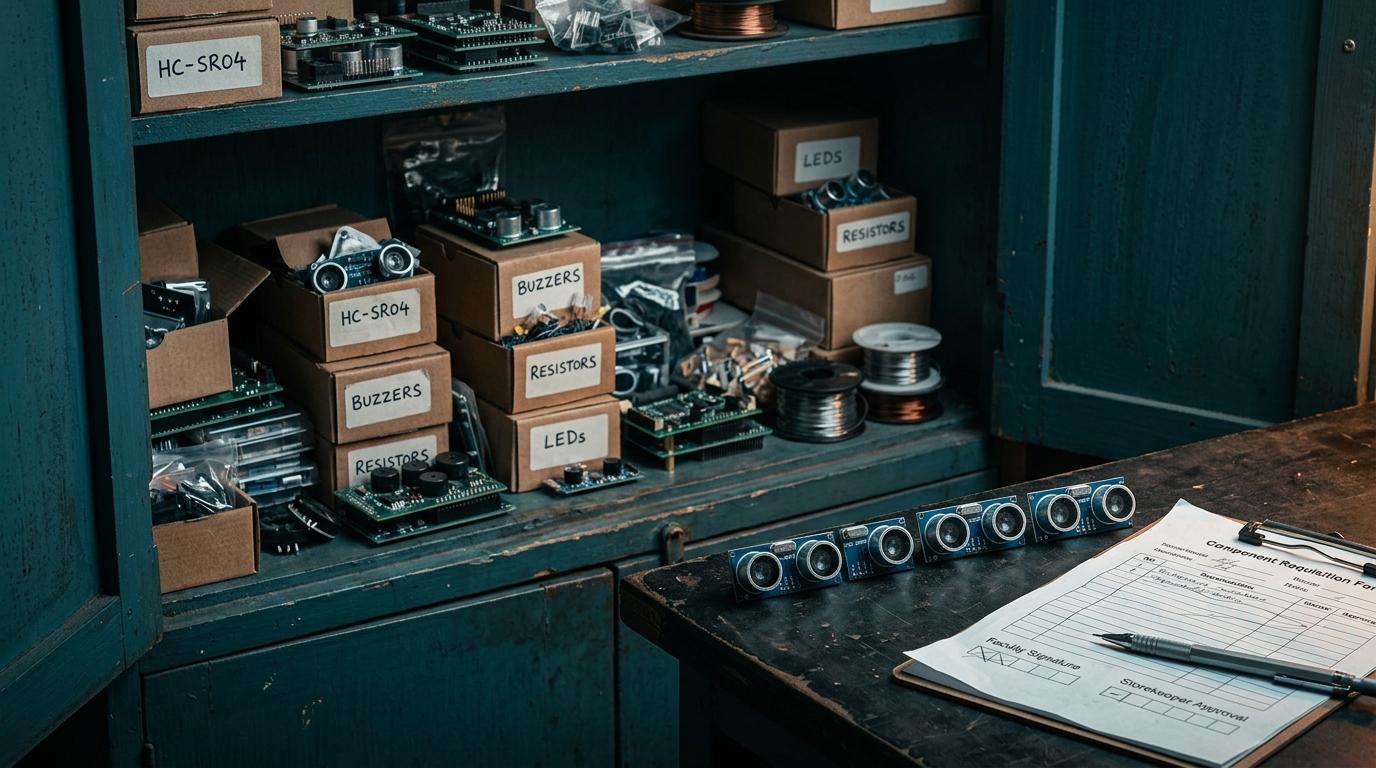
What changes this is a simple listing: I have X, I'm happy to share or sell it, here's how to reach me. When enough people do this in the same area, you get a network — a map of available components that updates in real time as things are used up or new surplus appears.
The friction has to be low. Posting a listing needs to take 2 minutes, not 20. The interface needs to be a phone app, not a procurement portal. And the transaction model needs to accommodate both free sharing (between classmates) and low-value sales (₹50 for a bag of sensors).
List your surplus. Find what others have.
The RoboDIB Component Map lets you publish available components from your inventory in one tap. Other makers in your area can see them and reach out directly.
What the network looks like when it works
Bangalore has enough active makers that a properly connected network would cover most common components within a few kilometres. The concentration in areas like BTM Layout, Koramangala, and around the major engineering colleges means that proximity isn't even really a constraint for most components.
It doesn't need to be comprehensive to be useful. Even 20% coverage — one in five urgent sourcing needs met locally instead of from a distributor — would meaningfully change the way projects get built. The momentum loss of waiting for delivery, even overnight delivery, is real.
The components already exist. The people who need them already exist. The missing piece is the connection.
More from the blog
RoboDIB
Solve these problems yourself
AI inventory, component map, 3D printing, and circuit design tools — all built for India's maker community.