SP Road is 40 Km Away and the Courier Takes 5 Days
The sourcing reality for most Indian makers — and what a local component network could change
If you live near Bangalore's SP Road, you have it relatively good. You can walk into a shop and walk out with what you need. But even that has become more complicated over the years — many shops have shifted to wholesale-only, minimum quantities are higher, and the stock of anything beyond basic passives is increasingly unreliable.
If you're in BTM Layout, Whitefield, Electronic City, or anywhere beyond 15 km of the old electronics market — that option isn't really an option at all. It's a 90-minute round trip in Bangalore traffic for something that might not be in stock when you get there.
And if you're not in Bangalore — if you're in Pune, or Kochi, or a tier-2 city with no dedicated electronics market — you're ordering everything online and building your project schedule around courier timelines.
The courier is the default, and it has real costs
For most makers in India, online ordering from the major suppliers is just how it works. And honestly, it's not bad — the catalogues are good, prices are reasonable, and delivery has got faster. But it's not friction-free.
- Minimum order amounts that mean you're buying 10x what you need for a small project
- Shipping costs that are sometimes larger than the component itself
- Delivery windows that are 2 days on paper and 5 days in reality
- The specific module or variant you need being out of stock
- Returns and replacements being genuinely painful
None of this is a dealbreaker for planned purchases. It becomes a problem when you're mid-project and you need one specific component today. That's when you start looking for alternatives.
The WhatsApp group solution (and its limits)
Every active maker community has figured out some version of this. There's usually a WhatsApp group, or a Telegram channel, where someone posts 'does anyone have a spare L298N?' and waits to see if a reply comes in. Sometimes it works beautifully. Sometimes you get three replies from people in different cities who can't help you in time.
The problem with the WhatsApp group approach is that it's entirely dependent on who happens to be online, who has the part, and whether they're willing to coordinate a handover. It works as a community but not as a reliable system.
"I needed a specific motor driver IC on a Friday afternoon. Posted in three groups. Got a response Monday morning from someone in Chennai." — Bangalore robotics club member
Find what you need from makers near you
The RoboDIB Component Map lets you see available components listed by other makers in your city. Browse, request, and pick up — no minimum order, no courier wait.
What makers actually have sitting unused
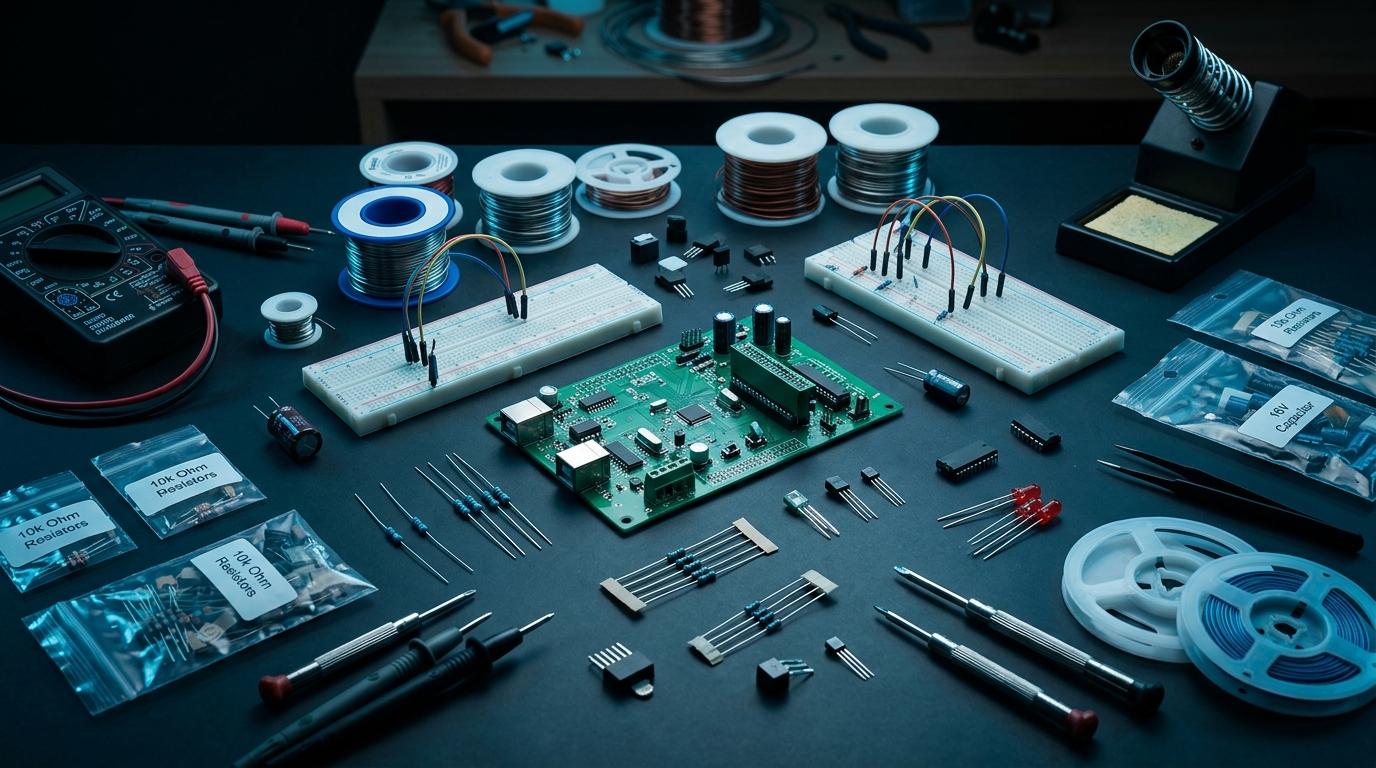
Here's the thing that often goes unnoticed: the maker community collectively holds a very large stock of components. Not in any one place — distributed across hundreds of workbenches, hostel rooms, home labs, and college project shelves. Components that were ordered for projects that ended, assortment packs where only a fraction was used, modules bought speculatively that never found a project.
Someone in your city almost certainly has what you need. The problem is you have no way of knowing who that is, what they have, and whether they'd be willing to share or trade.
The neighbourhood factor
This is actually more relevant in an Indian context than in most countries. We're used to borrowing things from neighbours, from college juniors, from the person in the next hostel block. The social infrastructure for this kind of informal sharing exists. What doesn't exist is the visibility — knowing that the person two streets over has exactly the DS18B20 sensors you need.
What a visible local supply network changes
If you could see what other makers near you have available — not as an informal request but as an actual browseable map — a few things would change.
You'd have a meaningful answer to the 'need it today' problem. The courier becomes a fallback rather than the first resort. Your community becomes an actual resource rather than just a social network.
And for the person who has excess stock — the DS18B20s from a batch order where you only needed five, the motor drivers from a project that changed direction — those components go from sitting in a drawer to being genuinely useful to someone else. That feels better than waste.
The trust piece
Any kind of peer supply network lives or dies on trust. Is the component genuine? Is the person reliable? Will the handover actually happen? These are fair questions, and the answer is the same as for any community: reputation matters. A system where people can see history, read feedback, and make informed decisions is more reliable than an anonymous marketplace. The maker community in India is already reasonably tight-knit in most cities. A good tool doesn't replace that social layer — it makes it work at a useful scale.
More from the blog
RoboDIB
Solve these problems yourself
AI inventory, component map, 3D printing, and circuit design tools — all built for India's maker community.