I Have 47 NE555 Timers and I Don't Know What To Do With Them
The excess stock problem that every maker accumulates — and why it's worth solving
Somewhere along the way, I became the person who bulk-ordered NE555 timers because the per-unit cost was so much lower. The minimum order was fifty. I needed maybe five. I used four. The other forty-three have been sitting in a small plastic bag in my component drawer for the better part of two years.
This happens constantly. Every maker I know has a version of this story, usually several versions, for different components.
How excess stock accumulates
It's almost never intentional. The bulk purchase logic makes perfect economic sense at the time — ₹12 each if you buy 50, ₹45 each if you buy 5. If you're going to use them eventually, why not buy in bulk now? Except 'eventually' often means never, or means using three more over the next year and still having forty-two.
- Assortment packs where you only needed two of the forty types included
- Project components that the project design moved away from
- Modules ordered to test or evaluate that worked fine but weren't used further
- Salvaged components from old electronics that you kept 'just in case'
- Free samples that came with a kit or from a supplier
Every category of maker — students, hobbyists, professionals — accumulates excess in different ways, but the outcome is the same: shelves and drawers full of components that are perfectly good but not being used.
The real cost of sitting on excess stock
The obvious cost is the money that's tied up. But there are less obvious costs too. Storage takes up physical space. More importantly, excess stock degrades your ability to find what you actually need — the more things are in the drawer, the harder it is to locate anything quickly.
There's also a psychological cost. A cluttered, overstuffed component collection is demoralising in a way that's hard to articulate. You look at it and feel like you should sort it out, and then you don't, and it stays in the background as a low-level source of stress.
"I threw out a working 433MHz receiver module last year because I couldn't remember what it was and assumed it was something old and useless. Two months later I needed one." — anonymous, sadly
List what you have. Someone nearby needs it.
The RoboDIB Component Map lets you publish your available components for other makers in your city to find and request. Turn drawer clutter into community value.
The component that's junk to you is gold to someone else
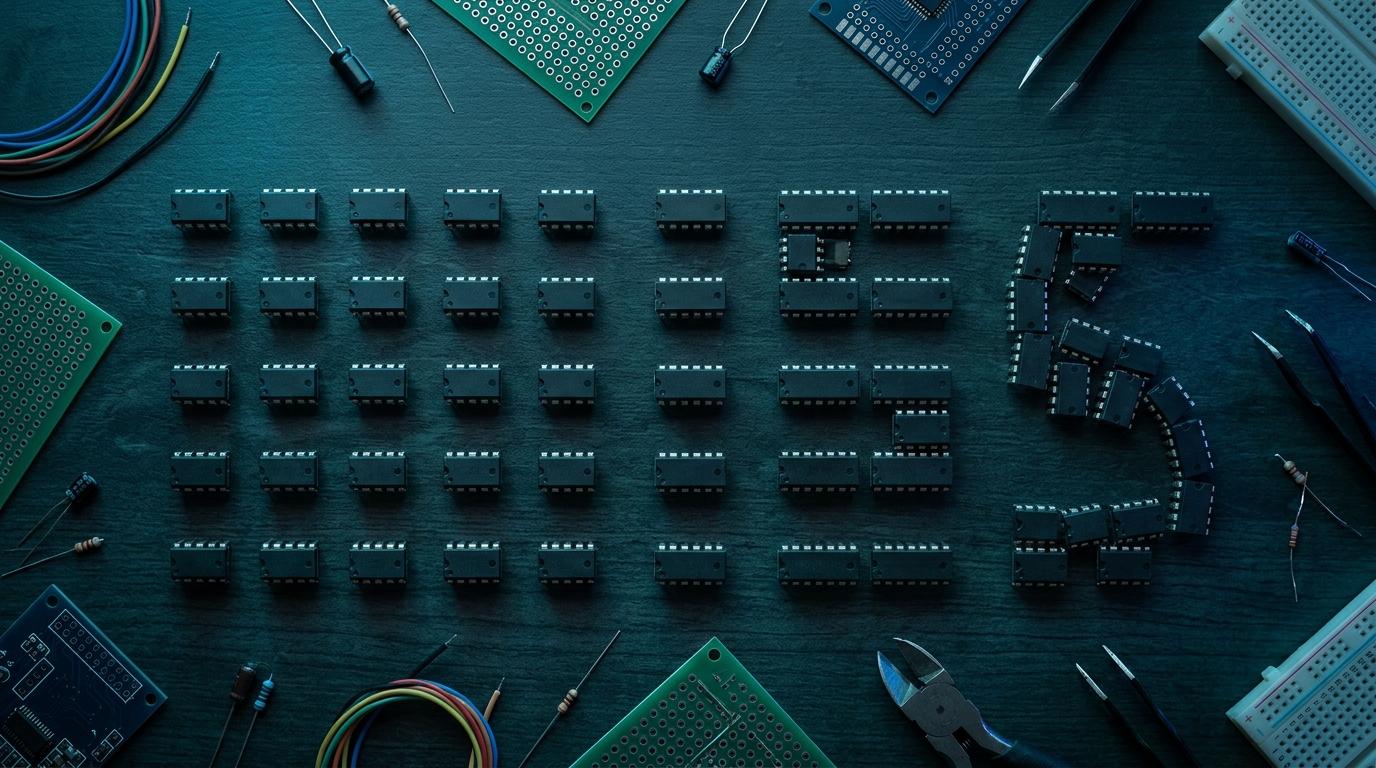
This is the thing worth sitting with: your forty-three NE555 timers are completely useless to you. But somewhere nearby, there's a student doing their first electronics project who needs exactly one NE555, has no idea where to source it locally, and is about to either pay ₹50 for a single unit plus ₹80 shipping, or wait three days for delivery.
The mismatch between what you have and what someone else needs is not a fundamental problem. It's a visibility problem. You don't know who needs it. They don't know you have it. If there were a way to bridge that gap locally, both parties would be better off.
This is how component sharing already works informally
In any active college electronics club or makerspace, there's usually an informal exchange that happens. Someone has too many of something, they leave it in a common area, someone else takes what they need. It works well at small scales — ten people in a room who all know each other.
What breaks down is scale and geography. It only works if you happen to be in the same room at the same time. The maker two streets away, or in the next neighbourhood, or at the college across town — they're effectively invisible to this exchange.
What changes when your excess is visible
If you could publish your available stock — not everything, just what you're happy to share or trade — it becomes findable. Someone nearby who needs it can see it, reach out, and arrange a handover. The component that was occupying drawer space becomes useful to someone. You free up space, someone else gets what they need, and the transaction happens without anyone waiting for a courier.
The friction of 'I have too much' and 'I need just one' resolves itself. And your forty-three NE555 timers stop being a mild source of guilt every time you open that drawer.
More from the blog
RoboDIB
Solve these problems yourself
AI inventory, component map, 3D printing, and circuit design tools — all built for India's maker community.