Why Do I Have 98 Transistors When I Needed 4
Minimum order quantities create surplus by design — here's what to do with it
You needed 4 BC547 transistors. The minimum order on Robu.in was a pack of 100. You paid ₹60, used 4 of them for the project, and now you have 96 in a small bag that's been in the second drawer for 14 months.
This is the minimum order quantity problem, and every maker deals with it. It's not waste exactly — the transistors are fine, they'll last decades — but it is inventory that has no plan. You didn't need 96. You have no project queued up that needs 96. They're just there.
The scale of the problem
Run through your component collection and count the things you have more than 10 of that you've used fewer than 5 of. For most makers with more than a year of activity, this is a substantial fraction of their inventory.
Resistors and capacitors in standard values aren't really a problem — you'll use them eventually. But ICs, sensors, specific modules — these accumulate fast. One project that doesn't use an IR sensor kit, one batch of relay modules that turned out to be overkill, one set of ESP8266 boards before you switched to ESP32.
- Sensor kits: ordered for a project that used one sensor, have five remaining.
- Relay modules: bought 4, used 1, have 3 collecting dust.
- Specific ICs: minimum pack of 5-10, used 1-2, have the rest.
- Development boards: upgraded to newer model, have old one sitting unused.
The false economy of hoarding
The logic most people apply is 'I might need it later'. And sometimes you do. But for most surplus components, the realistic probability of needing exactly that component in that quantity within the next two years is low. Meanwhile, it takes up space, it contributes to the clutter that makes your actual working inventory harder to navigate, and it has zero utility.
Compare this to the alternative: sell or give away the surplus at a fraction of the original cost. You get space back, you get a small cash return, and someone who actually needs it gets it now instead of ordering from a distributor and waiting.
"I cleared ₹2,200 in three weeks just selling components I'd written off as junk. Things I'd had sitting there for two years." — RoboDIB Component Map user, Koramangala
What good surplus pricing looks like
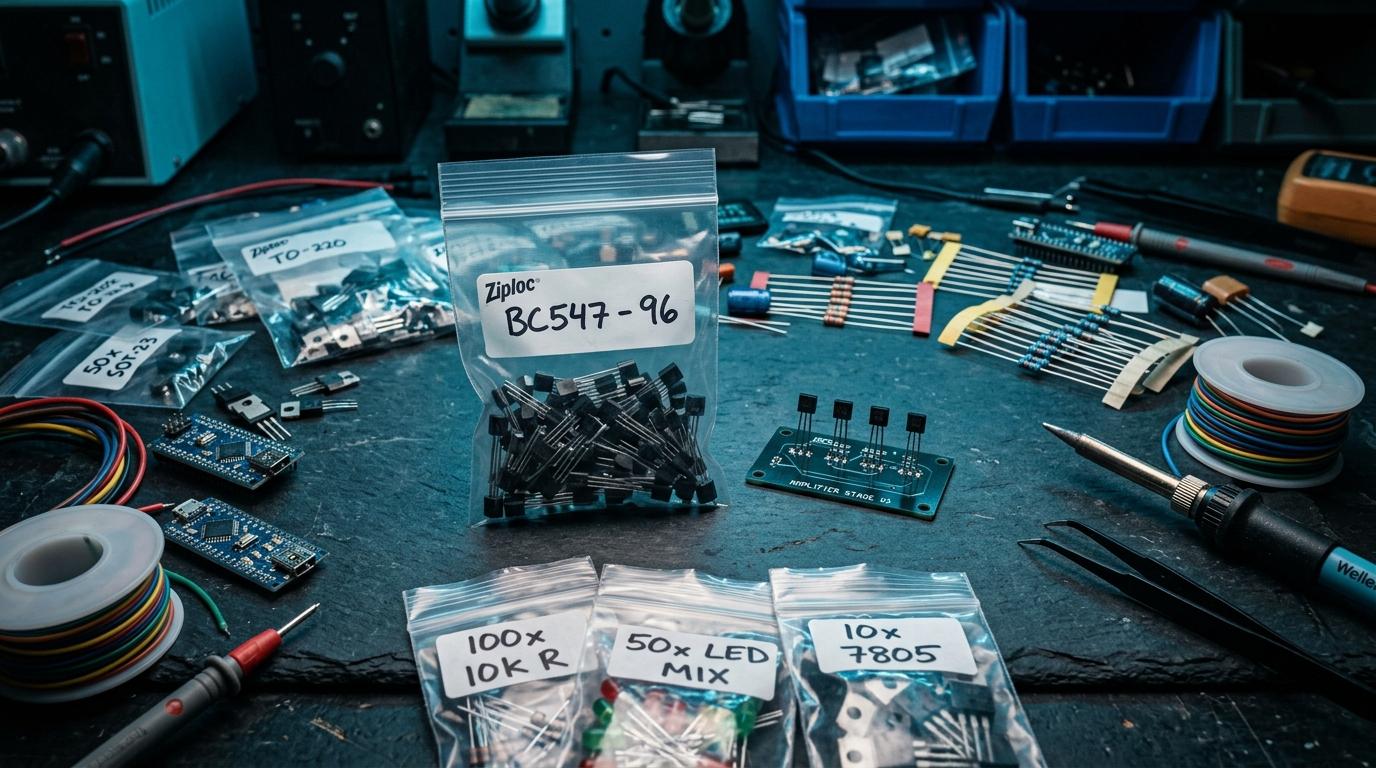
The right price for surplus components is somewhere between 'free' and 'what I paid'. You're not trying to profit — you're trying to move something that has zero utility to you but some utility to someone else. For most passive components, that's ₹20-50 for a bag. For modules and boards, ₹100-500 depending on what it is.
At those prices, transactions happen quickly. The buyer is happy because they're getting something cheaper than retail with no delivery wait. You're happy because you recovered something from dead stock and cleared space.
Turn your surplus into someone else's project
List your unused components on the RoboDIB Component Map. Makers nearby can see them, reach out, and collect in person. No shipping, no fees, no minimum quantities.
The minimum order problem gets better with a network
The deepest fix isn't just selling your surplus — it's changing how you source in the first place. If you know that three people in your area have BC547s available, you might not order 100. You might just message one of them and buy 10. Or get 5 for free in exchange for something you have surplus of.
This is how the component economy gets more efficient. Not by eliminating minimum order quantities — distributors will always have them — but by creating a secondary layer of small-batch local availability that absorbs and redistributes the surplus those minimums create.
More from the blog
RoboDIB
Solve these problems yourself
AI inventory, component map, 3D printing, and circuit design tools — all built for India's maker community.