Running Shared Electronics Inventory for a Small Team Without Going Insane
Personal inventory is hard. Shared inventory is a different animal entirely.
Running shared component inventory for a makerspace or small team is genuinely hard. It's not a bigger version of personal inventory — it has completely different failure modes.
Personal inventory fails because of laziness or inconsistency in one person. Shared inventory fails because of coordination problems, competing naming conventions, and the tragedy of the commons where everyone assumes someone else is keeping it updated.
What We Tried at Our Makerspace
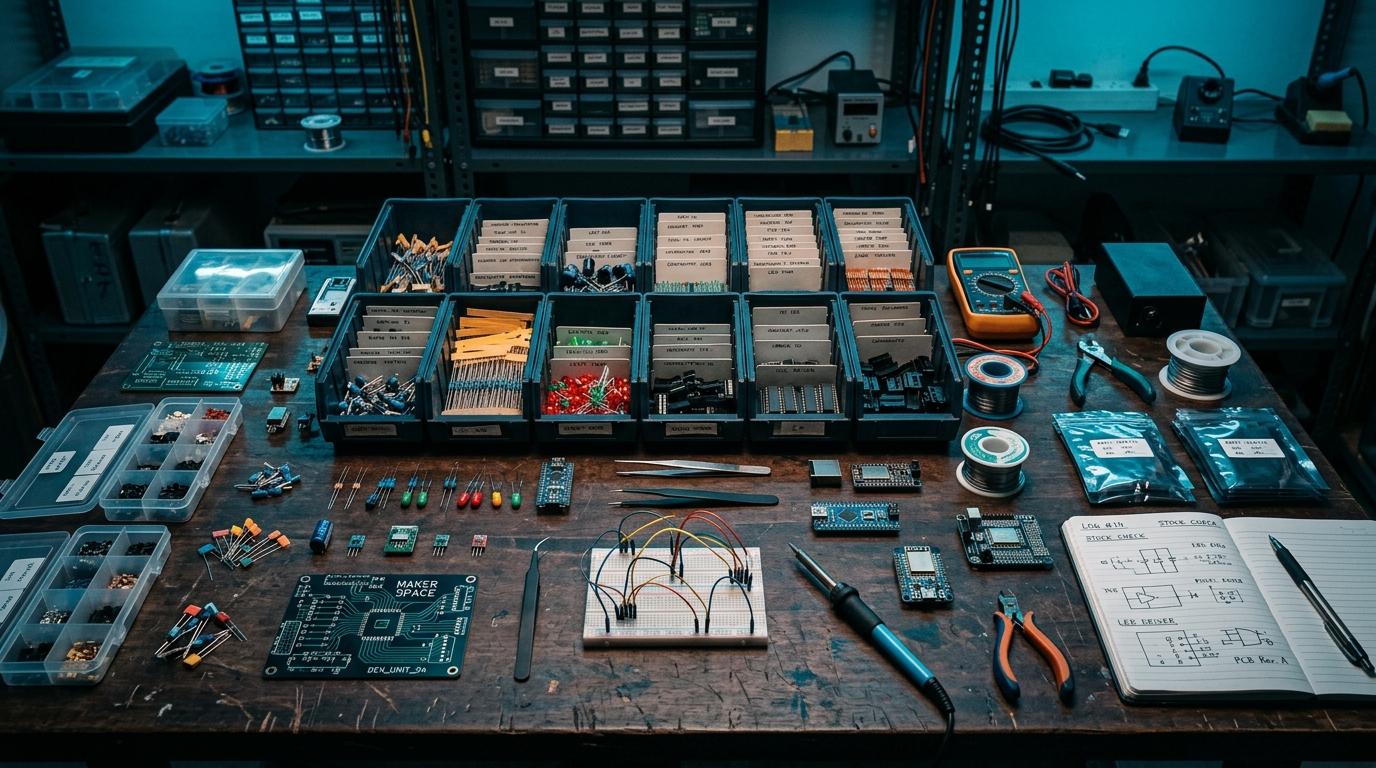
We're a small group — eight active members — at a shared workspace in Indiranagar. We tried three approaches over about 18 months before landing on something that actually held.
First: a shared Google Sheet with a 'checkout' tab. Every time you took a component, you were supposed to log it with your name, part, quantity, and date. This worked for about two weeks. Then people started logging inconsistently. Then they stopped entirely. The sheet became unreliable, so people stopped trusting it, so they stopped updating it. Spiral.
Second: physical labels on every bin with a count. You update the count when you take something. This is fine for slow-moving stock. For frequently used items — resistors, LEDs, jumper wires — the counts were always wrong because people were too lazy to update a physical label mid-project.
The failure mode of most shared inventory systems isn't dishonesty. It's the friction of updating competing sources of truth.
What Finally Worked
We switched to a system built around digital inventory with different collections per member, and a shared 'commons' collection for communal stock. Each member maintains their own collection. Nobody has to trust that someone else updated the shared sheet.
The commons collection is maintained by whoever uses it — but it's lower-stakes because it doesn't pretend to be precisely accurate. It's directionally correct. You can see if we're low on 10K resistors or if the commons is well-stocked. You don't rely on it for exact counts.
- Personal collections per member — each person owns their own accuracy
- Shared 'commons' collection for consumables and communal stock
- AI entry makes updating fast enough that people actually do it
- Search works across all collections so you can find where something is
The Key Insight
Shared inventory breaks down when it requires everyone to be equally diligent. The best systems make it easy to contribute without requiring it, then reward the people who do contribute by making their searches dramatically more useful.
If the person who does update consistently gets real benefit — faster finds, better project planning — they keep doing it. If it's pure obligation with no personal payoff, the discipline erodes fast.
Inventory that works for teams
Create collections for each team member. Share what matters. Keep your own stock private. One system, multiple workflows.
More from the blog
RoboDIB
Solve these problems yourself
AI inventory, component map, 3D printing, and circuit design tools — all built for India's maker community.