ESP32 vs Raspberry Pi for AIoT Projects — An Honest Comparison
They're not competing products. They solve different problems. Here's how to choose.
Every few months someone posts a 'ESP32 vs Raspberry Pi' comparison and the comments get heated in predictable ways. Raspberry Pi fans argue it can do everything the ESP32 can and more. ESP32 fans counter that the Pi is overkill, expensive, and fragile for embedded deployment.
Both are right for their use case. The comparison isn't useful because they're not really alternatives — they're different tools for different layers of the same problem.
What the ESP32 Is Good At
The ESP32 is a microcontroller with WiFi and Bluetooth. It runs firmware that you write, typically in C++ (Arduino) or MicroPython. It boots in milliseconds, runs forever on a battery (in deep sleep mode), handles real-time I/O reliably, and costs under ₹300 for a development board.
It's excellent for: sensor nodes, actuator controllers, wireless data collection, anything that needs to run for months on a battery or respond to hardware events with sub-millisecond latency.
- Boots in ~2 seconds, deep sleep current under 10µA
- Native hardware peripherals: UART, SPI, I2C, ADC, PWM, DAC, touch
- WiFi + Bluetooth 5 + ESP-NOW built in
- Runs on 3.3V, 80–240MHz dual core
- Price: ₹200–500 for dev board
What the Raspberry Pi Is Good At
The Raspberry Pi is a small Linux computer. It runs a full operating system. You can run Python scripts, Node.js servers, Docker containers, databases, and web interfaces. It has USB, HDMI, and more RAM than any microcontroller. It's not a microcontroller — it's a computer.
It's excellent for: the hub/gateway role in an AIoT system (runs the MQTT broker, processes data, serves the local dashboard), computer vision applications (runs TensorFlow Lite), media applications, anything that benefits from a general-purpose OS.
- Runs full Linux — unlimited software ecosystem
- USB, HDMI, 40-pin GPIO header
- Suitable for TensorFlow Lite inference, OpenCV, ML workloads
- Price: ₹3,000–8,000 depending on model
- Draws 2–7W — not practical for battery-powered nodes
The ESP32 is the edge node. The Raspberry Pi is the edge gateway. In a real AIoT system, you likely need both.
The Architecture Pattern That Works
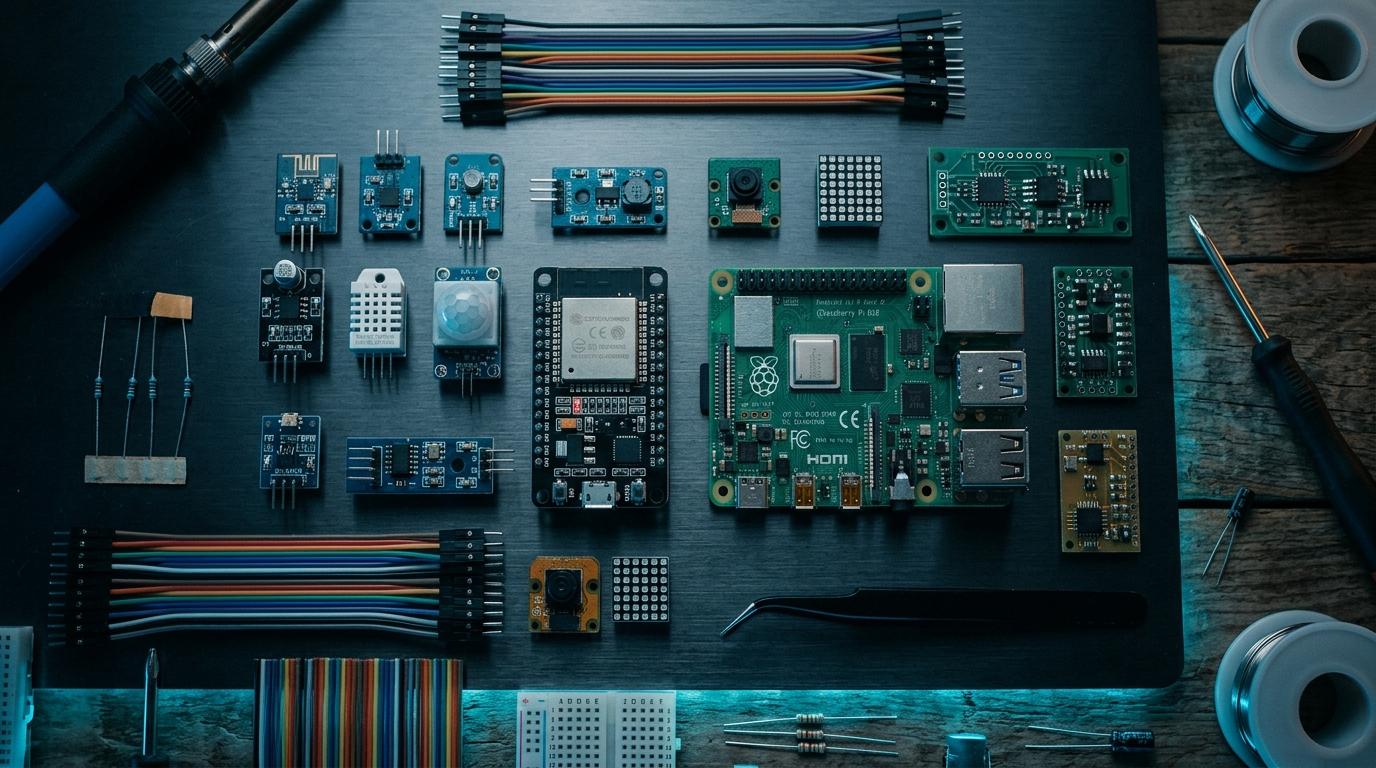
The practical AIoT architecture in most projects: ESP32 nodes at the sensor/actuator layer, communicating via MQTT or ESP-NOW. A Raspberry Pi (or similar) as the hub, running the MQTT broker (Mosquitto), a local database (InfluxDB), and a dashboard (Grafana or Node-RED).
The ESP32s are cheap enough to deploy many of them. The Pi provides the computing power and storage for aggregation, analysis, and visualization. This separation of concerns maps cleanly to the hardware trade-offs of each platform.
For Pure Beginners: Start With ESP32
If you're just starting with AIoT, start with ESP32 and Arduino. The feedback loop is faster, the cost of mistakes is lower, and you build intuition for the hardware layer that makes the Pi layer more meaningful when you get there. The Pi is easy to buy but hard to use well without the embedded fundamentals.
Start your AIoT project
RoboDIB stocks ESP32-based AIoT modules and gateway-ready compute units designed for Indian maker projects.
More from the blog
RoboDIB
Solve these problems yourself
AI inventory, component map, 3D printing, and circuit design tools — all built for India's maker community.