The Tiny Text Problem — When You Can't Read Your Own Components
Unmarked bags, worn markings, and the 20 minutes you spend staring at a chip trying to figure out what it is
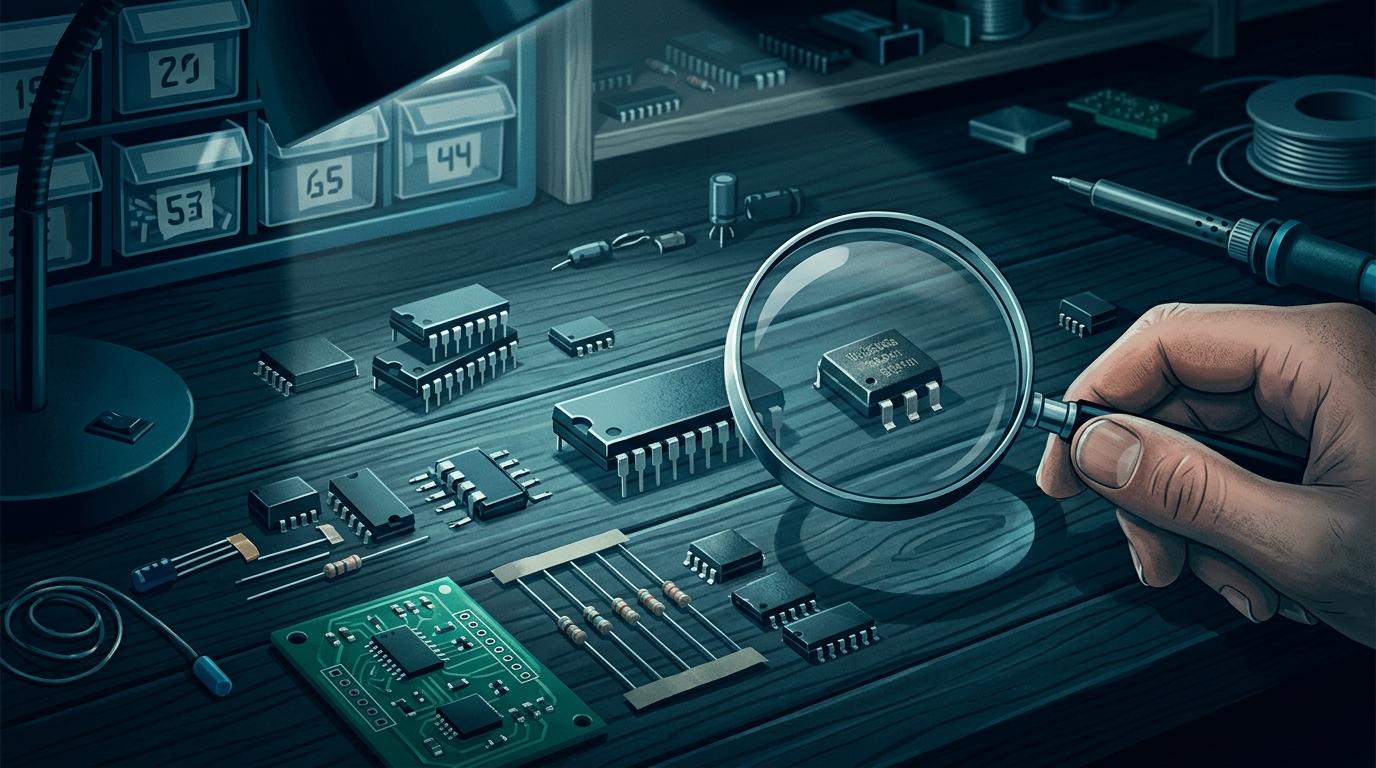
Hold the component under the desk lamp, squint, turn it over. Still can't read it. You're almost certain it's a 7805 but you're not completely sure and the 7905 is a negative regulator and you've already damaged one board this week.
This happens constantly with components sourced from local vendors, bought in bulk, or just stored for a few years. The silkscreen fades. The packaging gets separated from the part. The bag you put them in didn't have a label. Now you have 12 identical-looking black ICs and no idea which is which.
Why this keeps happening
It's not always carelessness. Bulk orders from SP Road or local vendors sometimes come in plain anti-static bags with no label at all — you're meant to know what you bought because you just bought it. And you do know, at that moment. Six months later, you don't.
Thermal labels on bags fade. Marker on components smears. You split a bag and put half in a different container and now neither container is fully labelled. These are normal events in a real workspace, and there's no way to prevent all of them.
The guessing problem is a safety problem
For passive components — resistors, capacitors — a wrong guess usually means a circuit that doesn't work as expected. Annoying, but debug-able. For ICs and voltage regulators, a wrong guess can mean connecting 12V to a circuit designed for 3.3V. That destroys components. Sometimes it creates a safety hazard.
The right response when you can't read a marking is to not use the component until you're sure. But that means either wasting time trying to identify it, or ordering a new one and waiting.
- Unknown transistor: substitute the wrong polarity, immediate failure.
- Mystery voltage regulator: wrong output voltage, destroyed downstream components.
- Unlabelled capacitor: wrong voltage rating, capacitor failure on power-up.
- Unidentified IC: completely unknowable behaviour.
The discipline that prevents this
The only reliable fix is upstream: label at the point of storage, not the point of use. When components arrive, they go into labelled containers before anything else happens. This takes maybe 2 minutes per order and saves 20 minutes every time you try to find something later.
The problem is that this requires a container system, a labelling system, and the discipline to do it consistently. Most makers start with good intentions and slip on the discipline part within a few weeks.
What the inventory record gives you
If you have an inventory record that says 'tray 3, slot 2: 7805 voltage regulators, 14 units, purchased April 2025' — then the mystery disappears. You don't need to read the marking because you know what's in that location.
The record becomes the label. And unlike a physical label, it doesn't fade, it doesn't fall off, and it's searchable.
Add components in 30 seconds, find them in 5
RoboDIB AI Inventory turns supplier invoices and plain descriptions into a searchable database. Location tagging means you always know which bin, drawer, or shelf.
The rule that works
Makers who've solved this tend to use a simple rule: nothing gets put away without a record. Doesn't matter how small the batch, doesn't matter how obvious the component. If it's going into storage, it gets logged.
It feels like overhead. It saves hours. And it means you never have to hold a chip under a lamp squinting at the markings again — because you already know what it is.
More from the blog
RoboDIB
Solve these problems yourself
AI inventory, component map, 3D printing, and circuit design tools — all built for India's maker community.