From BOM to Bench Without Losing a Day to Sourcing
The gap between a bill of materials and having parts in hand is where projects die
You finish the schematic at midnight. The BOM has 34 line items. You have 11 of them. The rest need to be sourced, and you have no fast way to figure out which.
So you do what everyone does: you open the BOM, you open your component drawer, and you start going through it manually. An hour later you've found maybe 8 more parts, you're not sure about three of them because the markings are worn off, and you still have 15 items you definitely don't have. Except you also found a bag of things you forgot you bought six months ago and might contain what you need.
This is the BOM gap — and it's the most consistent way a project loses an entire day before it even starts.
Why the BOM gap happens
It's not that people are disorganised. It's that there's no fast path from 'here is a list of things I need' to 'here is what I have and what I need to buy'. That path requires two things: knowing what you currently own, and being able to match it against an arbitrary list.
Both of those are hard to do manually. Your inventory lives in your head, in a rough approximation, not as a queryable database. Your BOM is a spreadsheet or a PDF that you can't automatically compare against anything.
The result is that even experienced makers routinely order parts they already have, or spend an hour doing a manual reconciliation that should take five minutes.
The parts you definitely have but can't find
There's a specific category of frustration here that's worse than just not having something: having it but not being able to find it. The 100nF capacitor you definitely ordered a bag of. The voltage regulator you used on the last project and put 'somewhere safe'. The specific pin header that you know is in the second drawer but the second drawer has four trays in it.
- You order a duplicate. Two days wait, extra spend.
- You improvise with something close. Creates a bug you trace for hours.
- You dig for 45 minutes and find it. Lost morning, killed momentum.
- You skip that section and come back. Project fragment, never finished.
"The hours I've lost to 'I know I have this somewhere' probably add up to a full week of making time." — maker at Bangalore Hackspace, 2025
What a proper inventory actually gives you
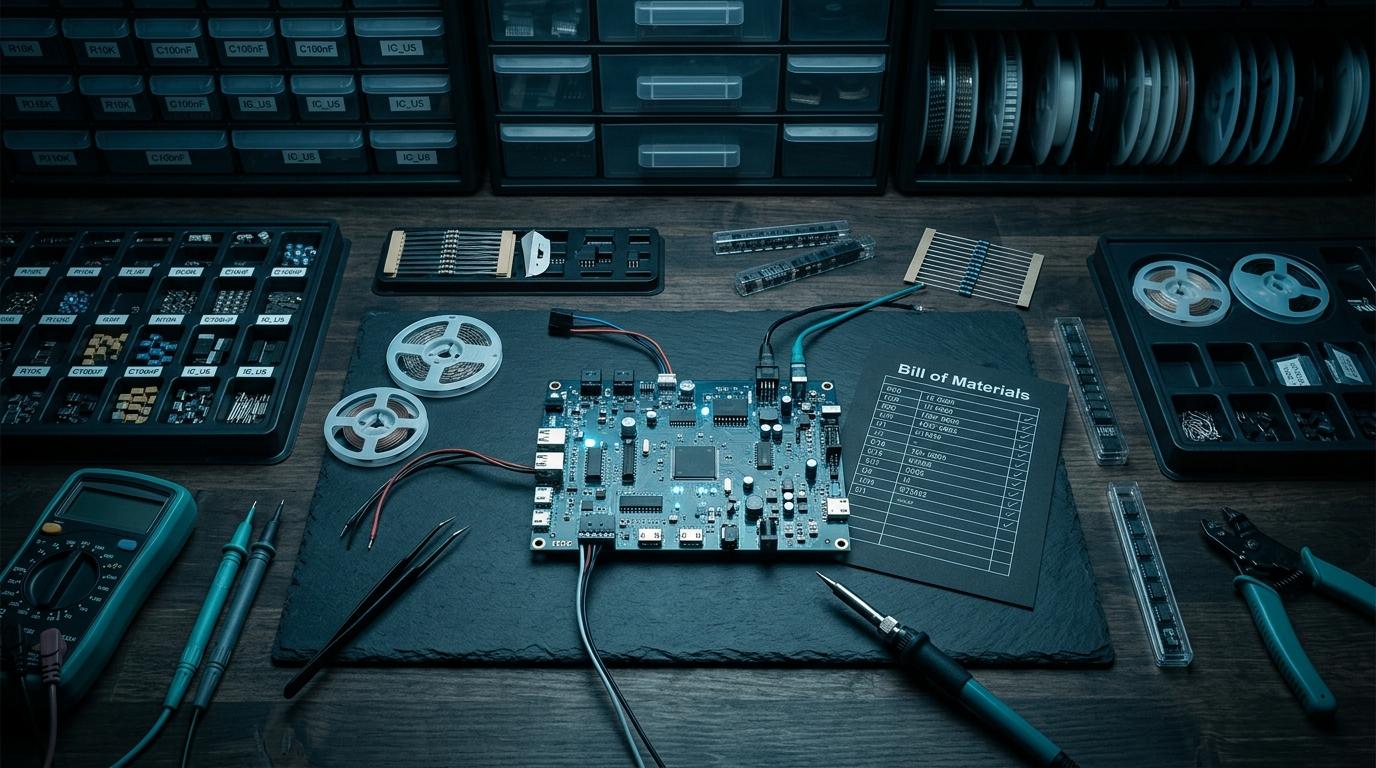
The useful version of an inventory isn't a stockroom-style count of every resistor. It's a fast answer to: do I have this, roughly how much, and where did I put it. That's the query that matters when you're mid-project.
And the best format for that is something you can match against a BOM without doing it by hand. Paste the list in. Get back: 'you have these 18, you're short on these 9, these 7 are ambiguous'. That's the output that actually moves a project forward.
The add-as-you-go problem
The other half of this is adding components to your inventory without it being a chore. The only sustainable approach is one where adding a new order takes 30 seconds, not 5 minutes. Paste a supplier invoice, paste a description, paste a forwarded WhatsApp message from a vendor — and have it parse automatically.
If the friction of adding something is lower than the friction of finding it later, people will actually maintain the inventory. If it's not, they won't, and the whole system degrades back to mental model plus shoebox.
Paste your BOM, see what you have
RoboDIB AI Inventory matches your component list against your stock in seconds. Add parts from supplier invoices or plain text. Know before you order.
The workflow that actually works
The makers who consistently finish projects without sourcing chaos tend to do one thing differently: they treat every order confirmation as an inventory update. Component arrives, gets added. Takes 60 seconds if the system is fast enough.
When you start a new project, your first step is a BOM reconciliation: what do I have, what do I need. You run it once, you order the shortfall, and you know you're not going to be blocked by a missing part on day three.
It's not a complicated workflow. The only reason most people don't do it is that the tooling to support it hasn't existed. A spreadsheet is too slow to maintain. A database is too much setup. The middle path — fast text input, smart parsing, BOM matching — is what actually gets used.
The BOM gap costs more project time than almost any other single thing. Not because it's hard to solve — it's genuinely a solved problem once you have the right tool — but because most people are still solving it manually, every time.
More from the blog
RoboDIB
Solve these problems yourself
AI inventory, component map, 3D printing, and circuit design tools — all built for India's maker community.