Why Can't Someone Just Print Me 2 Pieces?
The minimum quantity problem that stops makers from accessing 3D printing for small projects
I needed a small enclosure for a temperature and humidity sensor node. Just a box, really — a place to put the PCB, with a slot for the sensor to breathe and a small opening for the USB port. Not complex. Standard PLA, any colour, 0.2mm layer height. I designed it in about an hour in Fusion 360.
Then I spent the next two hours trying to find someone to print two of them at a reasonable cost and timeline. This took longer than designing the part.
The minimum quantity problem
Professional 3D print services are generally optimised for production runs. That makes business sense — setting up a print, doing quality checks, packaging and shipping, all for two small parts — the economics are genuinely difficult at that scale. So they set minimums, or they price small quantities in a way that reflects the overhead.
For a maker doing a small home automation project, ₹400 per enclosure (plus shipping) for something I could theoretically print at home for ₹30 in filament cost is a tough value proposition. I'm not running a business. I don't have a budget line for production costs. I just need two boxes.
What the options actually look like
- Online services: good quality, but 5-7 day delivery and pricing that assumes higher quantities
- Local makerspaces: sometimes available, but membership required and machine availability is unpredictable
- Ask a friend with a printer: great when it works, but you're dependent on their schedule and filament stock
- Buy your own printer: overkill for two enclosures a year, and you still have the learning curve
None of these are perfect for the specific use case of 'I have a finished design, I need 2 units, I'd like them within a day or two, and I don't want to spend more than the project is worth'.
The learning curve trap
A lot of makers just buy a printer to solve this problem. And then spend the first two months learning to use it — levelling the bed, tuning retraction, dealing with stringing and warping, figuring out why the first layer won't stick, reprinting failed prints.
This is genuinely useful knowledge if you're going to print regularly. But if your use case is two enclosures per project and maybe four projects a year — the learning investment is enormous relative to the actual output. You'd have been better off paying someone local who already knows the machine.
"I bought a printer for a project. The project took two weeks. Getting the printer calibrated and printing reliably took six weeks." — a friend who now admits this readily
2 pieces is fine. We print small runs.
RoboDIB's 3D print service in Bangalore accepts small orders with no minimum. Upload your STL, pick your material, get it same or next day.
What small-run printing should look like
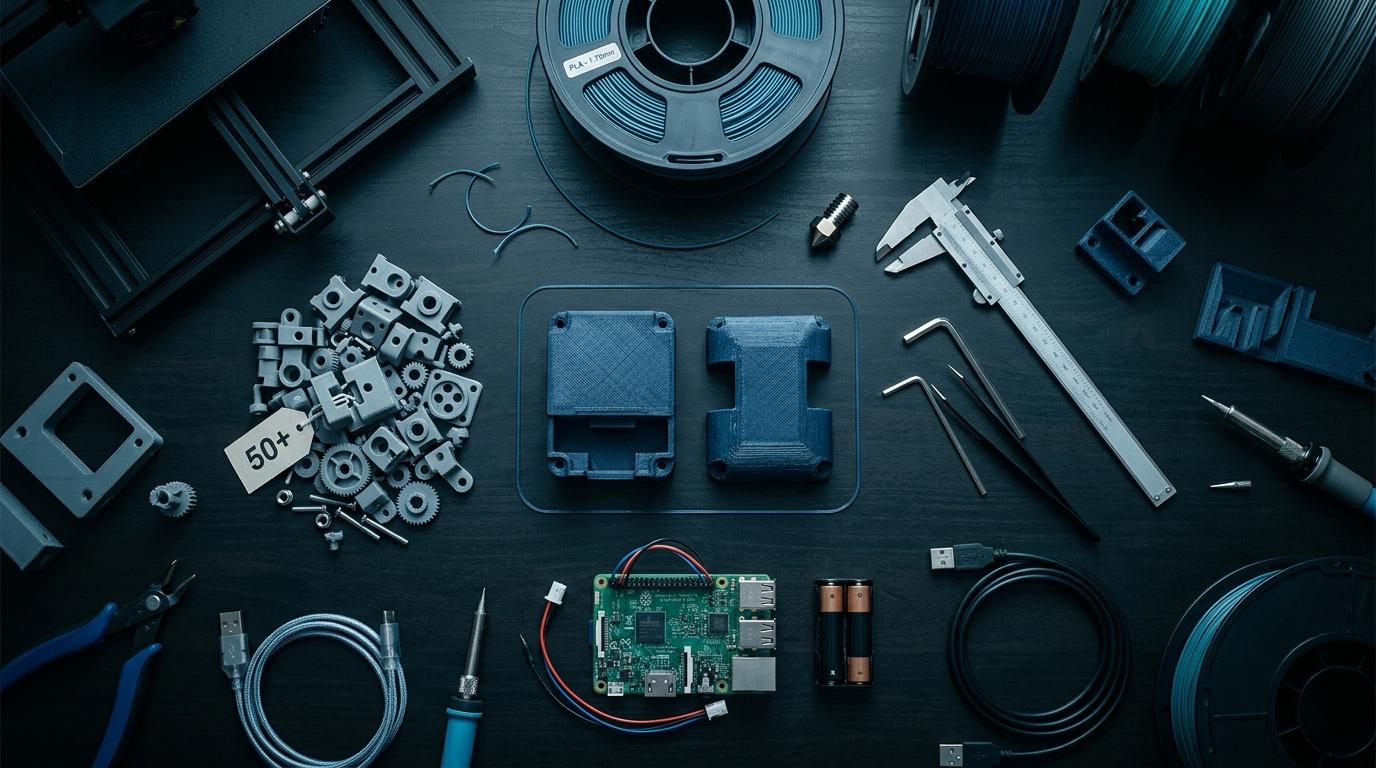
The ideal experience for a maker who needs a small number of custom parts is actually quite simple in theory:
- Upload or share the STL file
- Specify material, colour, and any critical tolerances
- Get a price and timeline that's honest and upfront
- Have the part ready in a day or two, not a week
- Be able to iterate quickly if the first print needs adjustment
The 'iterate quickly' point is particularly important for functional parts. An enclosure might need a slight adjustment to the USB port opening after you see the first print. A bracket might need the hole positions tweaked. With a local service, iteration means another print tomorrow. With a courier service, it means another week.
The Bangalore context
Bangalore has a reasonably active maker community and, accordingly, a few decent options for local printing. But awareness of these options is patchy — people either know exactly where to go, or they're stuck searching online and ending up with national services that don't solve the timeline problem.
Two pieces. That's really all I wanted. It shouldn't require a research project to figure out how to get them.
More from the blog
RoboDIB
Solve these problems yourself
AI inventory, component map, 3D printing, and circuit design tools — all built for India's maker community.