Soldering for Drone Builders — The Joints That Matter Most
Bad solder joints don't fail in testing. They fail at full throttle 50m up. Here's how to do it right
A cold solder joint on a breadboard project is annoying. A cold solder joint on a drone's power connector at 80A draw is a fire hazard that ends in a crash. The margin for bad solder work in a flying build is basically zero.
This isn't about theory. It's about the specific joints that fail and how to make them properly.
Your Iron Temperature Matters More Than You Think
For drone work — XT60 connectors, ESC pads, motor wires — you need 350–400°C. Most beginners run their irons too cold, which means they need to hold the iron longer, which overheats the insulation and components while the solder joint itself stays cold. Hot iron, fast contact, quick release.
Tinning: Do It Every Time
Before you connect anything, tin both the wire end and the pad. Tinned surfaces wet together instantly — the final joint takes under 2 seconds of iron contact. Untinned surfaces fight back and produce cold joints. Every wire, every pad, every time.
XT60 Connectors
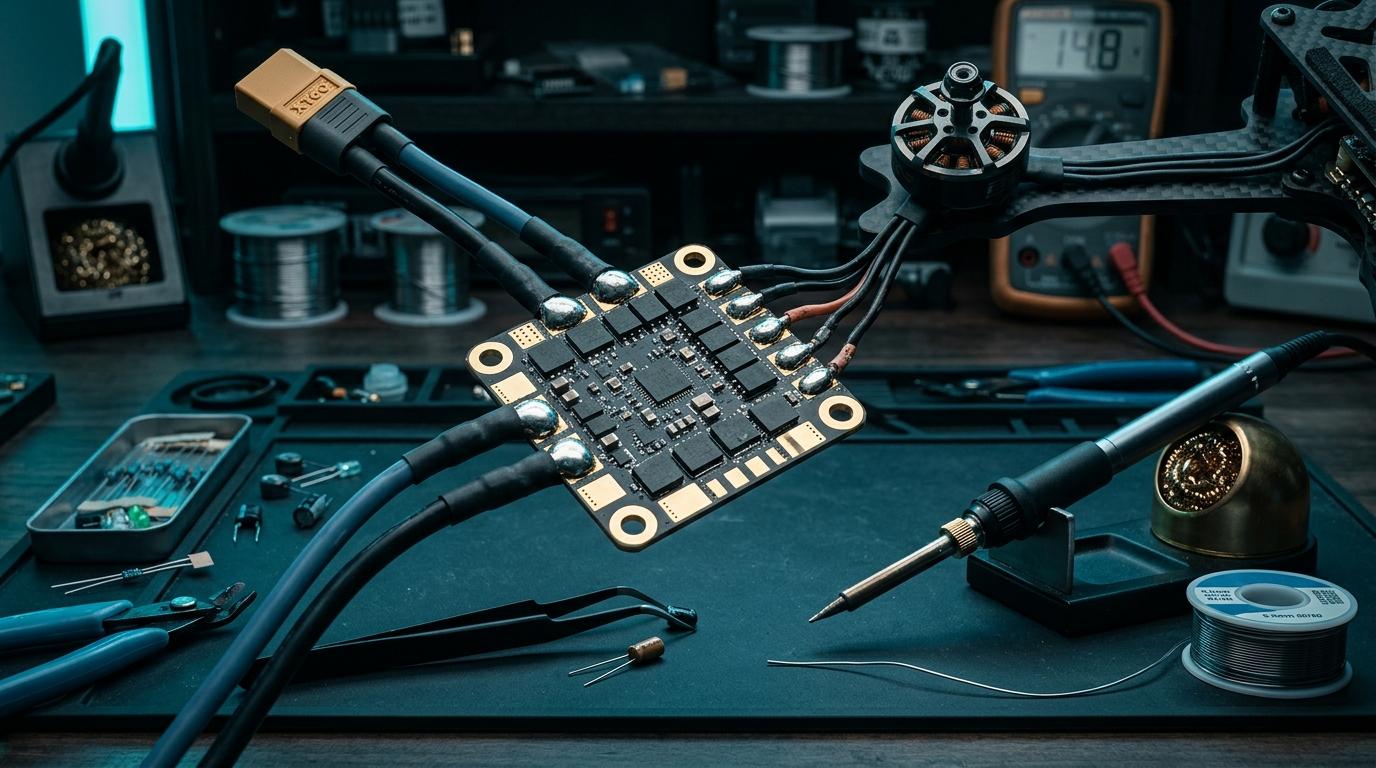
XT60s carry 60A continuous and up to 120A burst. The cups are large because that's the only way to get a reliable high-current joint. Use flux, fill the cup 80% with solder, then push the tinned wire in and add just a touch more solder while heating. Don't stab the wire in and hope. Insert at the right moment when the cup solder liquifies.
Motor Wire to ESC Pads
ESC motor pads are small and on a component that gets hot. Short wire runs reduce resistance. Leave 2cm of motor wire if space allows — long wires flap and can short against frames. The joint needs to be shiny, smooth, and slightly convex — not blobby, not grey/dull.
Signs of a Bad Joint
- Dull, grey, grainy surface — cold joint, needs to be reflowed
- Blob that moves when pressed — didn't bond, only bridged
- Wire pulls out with light tension — cold joint or incomplete fill
- Burn marks on insulation — iron held too long due to cold technique
Need soldering equipment or drone components?
Find irons, flux, XT60s, and motor/ESC combos from makers on RoboDIB.
More from the blog
RoboDIB
Solve these problems yourself
AI inventory, component map, 3D printing, and circuit design tools — all built for India's maker community.