KV Rating on Drone Motors — What It Means and Why You Should Care
Stop picking motors by brand. Learn what KV actually does to your throttle feel, efficiency, and prop selection
KV doesn't stand for kilovolts. It's RPM per volt — how many rotations per minute the motor spins for every volt applied with no load. A 2400KV motor on 4S (14.8V nominal) would theoretically spin at ~35,000 RPM unloaded.
In practice you always have a prop on it, so real RPM is lower. But KV tells you a lot about how the motor behaves.
High KV vs Low KV
High KV motors spin fast and produce peak thrust quickly — they're responsive and snappy. But they need smaller, lighter props to not overheat. Low KV motors spin slower but can swing larger, heavier props efficiently — great for cinematic or long-range builds where efficiency matters more than instant response.
The Battery Voltage (S count) Connection
KV and voltage scale together. If you double the voltage (go from 3S to 6S), you need roughly half the KV to get the same thrust output. This is why 6S builds use 1700–1900KV motors while 4S builds use 2300–2450KV. Running a high-KV motor on high voltage will overheat it fast.
What KV to Pick for Common Builds
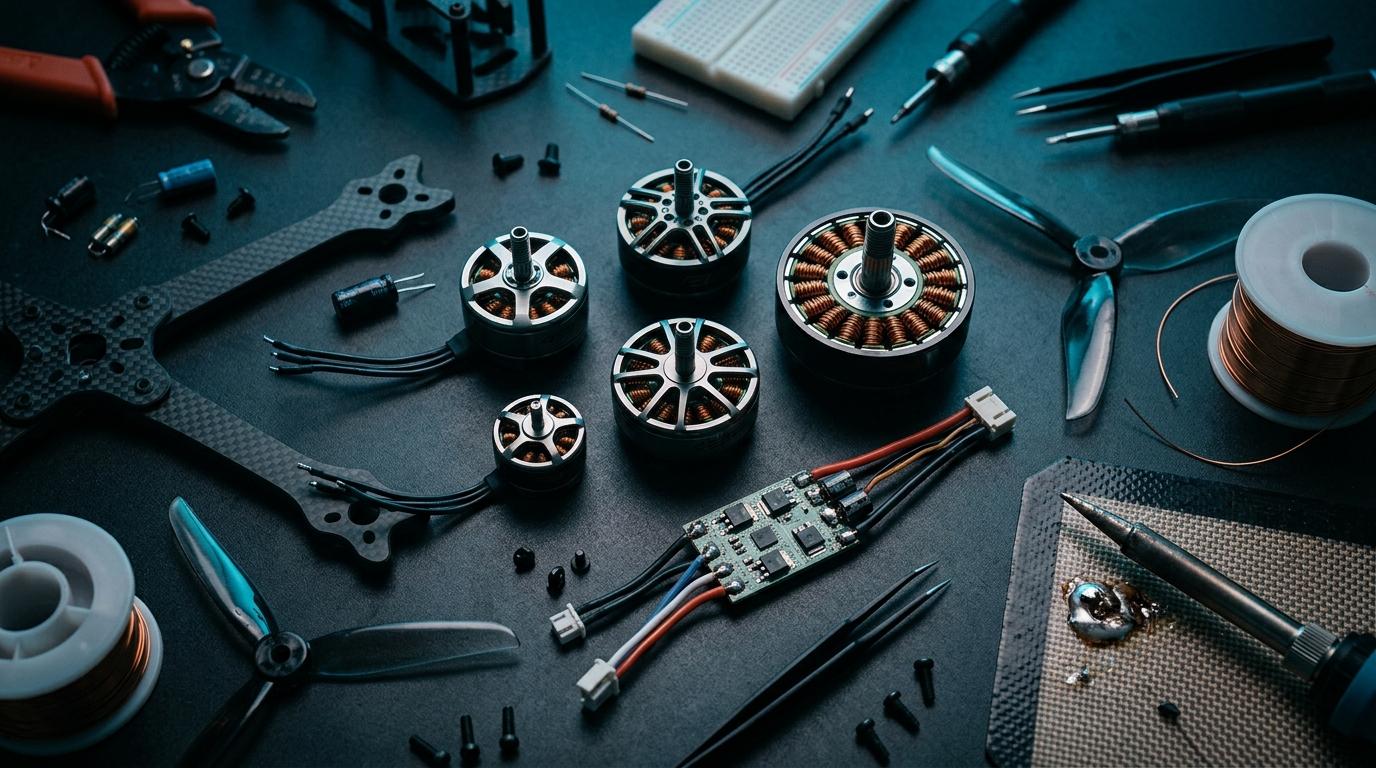
- 5" freestyle / racing on 4S: 2300–2450KV
- 5" on 6S: 1700–1900KV
- 3.5" or 4" on 4S: 2500–3000KV
- 7" long range on 4S: 1700KV
- 3" toothpick or ultralight: 3000KV+
The Prop Diameter Rule
Prop pitch and diameter determine how much air you're moving. A 5050 prop (5" diameter, 50mm pitch) on a high-KV motor is a common freestyle combo. Never run a prop larger than the motor was designed for — the winding temperature rises dramatically.
If you're buying motors locally or from hobbyist listings, always check what props the original owner was running. That's a quick sanity check on whether the KV fits your planned setup.
Building a drone and need specific motors?
Find motors, props, and ESCs from hobbyists who've already used them in FPV builds.
More from the blog
RoboDIB
Solve these problems yourself
AI inventory, component map, 3D printing, and circuit design tools — all built for India's maker community.