How to Actually Read a Datasheet Without Getting Overwhelmed
Datasheets are not meant to be read cover to cover. Here's the ten-minute technique.
The first time I tried to read a datasheet was for the L298N motor driver. The document is thirty-six pages long. It has graphs of saturation current versus temperature, application circuit variations I'd never use, and package thermal resistance specifications. I read the first five pages, understood nothing useful, and closed it.
Then someone showed me the right way to read a datasheet. It took ten minutes and I had everything I needed. Here's the approach.
What You Actually Need From a Datasheet
Unless you're designing for production or edge cases, you need four things: what the component does (one paragraph from the overview), the pin diagram (which pin is which), the absolute maximum ratings (what will destroy it), and the typical application circuit (how to connect it).
Everything else in the document is for edge cases, production engineers, or application-specific optimization. You don't need it for a prototype.
- Overview section: what it does and main specifications
- Pin diagram or pin description table: which pin does what
- Absolute maximum ratings: voltage, current, temperature limits — never exceed these
- Typical application circuit: the reference schematic, usually in the last quarter of the document
- Electrical characteristics table: operating voltage range, logic level thresholds
The Absolute Maximum Ratings Are Sacred
This table is the most important part of any datasheet for a builder. It specifies the values beyond which the component is not guaranteed to survive. Not 'might work,' not 'usually works' — not guaranteed to survive. At Absolute Maximum, you're operating without a safety margin.
Real working range is typically 20–30% below absolute maximum. If a MOSFET has VGS absolute maximum of ±20V, don't drive it with more than ±15V in practice. If a voltage regulator input absolute maximum is 35V, don't run 33V through it expecting it to be fine.
Absolute Maximum Ratings are the boundary between 'probably works' and 'might catch fire.' Stay below them with margin.
The Typical Application Circuit
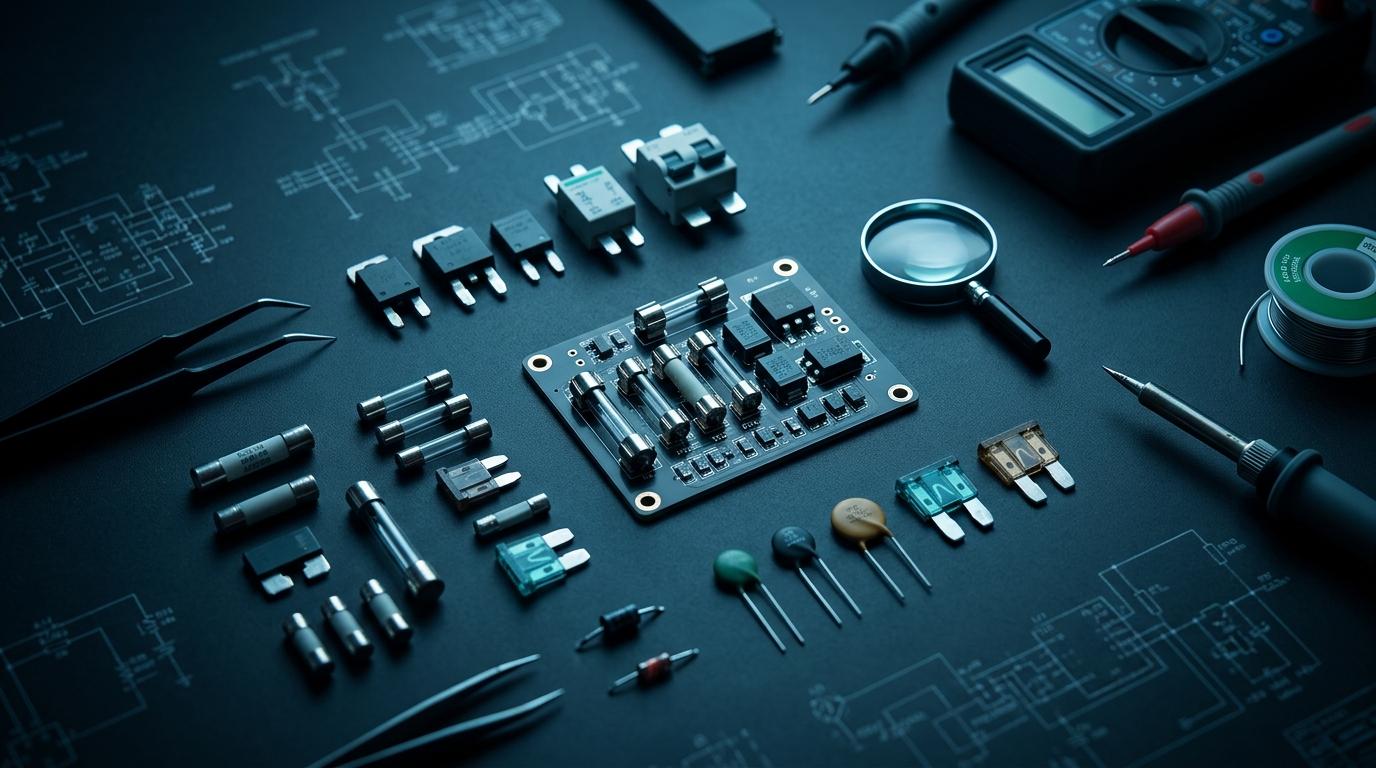
The typical application circuit at the end of a datasheet is the manufacturer's own reference design. It shows exactly what external components are required, what values to use, and how to connect everything. This is not a suggestion — it's tested, working circuitry.
Most beginner circuit failures are deviations from the typical application circuit. Before you get creative, get the basic circuit working exactly as the datasheet specifies. Then make changes one at a time.
When to Read More Deeply
For most prototypes, the above is enough. Read more deeply when: you're having unexplained failures (check timing diagrams and logic level requirements), you're optimizing for power consumption (check operating modes and shutdown currents), or you're designing for production (check temperature characteristics, derating curves).
Design circuits with component intelligence
Circuit Breaker surfaces the specifications you need from component libraries — so you design right from the start.
More from the blog
RoboDIB
Solve these problems yourself
AI inventory, component map, 3D printing, and circuit design tools — all built for India's maker community.