I've Killed at Least 11 L293D Motor Drivers. Here's What I Learnt.
The wiring mistakes that destroy components — and why they keep happening to careful people
The L293D is practically indestructible. It's rated for 600mA per channel, has built-in flyback diodes, and can handle up to 36V. I've killed eleven of them.
At some point it stops being bad luck and starts being a pattern. Here's what I found.
Mistake 1: Not isolating the motor power supply
The L293D has two power rails: Vcc1 (5V for the logic) and Vcc2 (motor power, up to 36V). Most tutorials show a single 5V supply powering both. That works until your motor draws enough current to cause voltage fluctuations that corrupt the microcontroller's logic. Separate power rails, always.
Mistake 2: No flyback diodes on inductive loads
The L293D has internal flyback diodes, but only if you enable them correctly. Read the datasheet: you need to connect the enable pins and use the right configuration. I spent three weeks not understanding why motors were killing my ICs. One line in the datasheet.
Mistake 3: Stalling motors under load
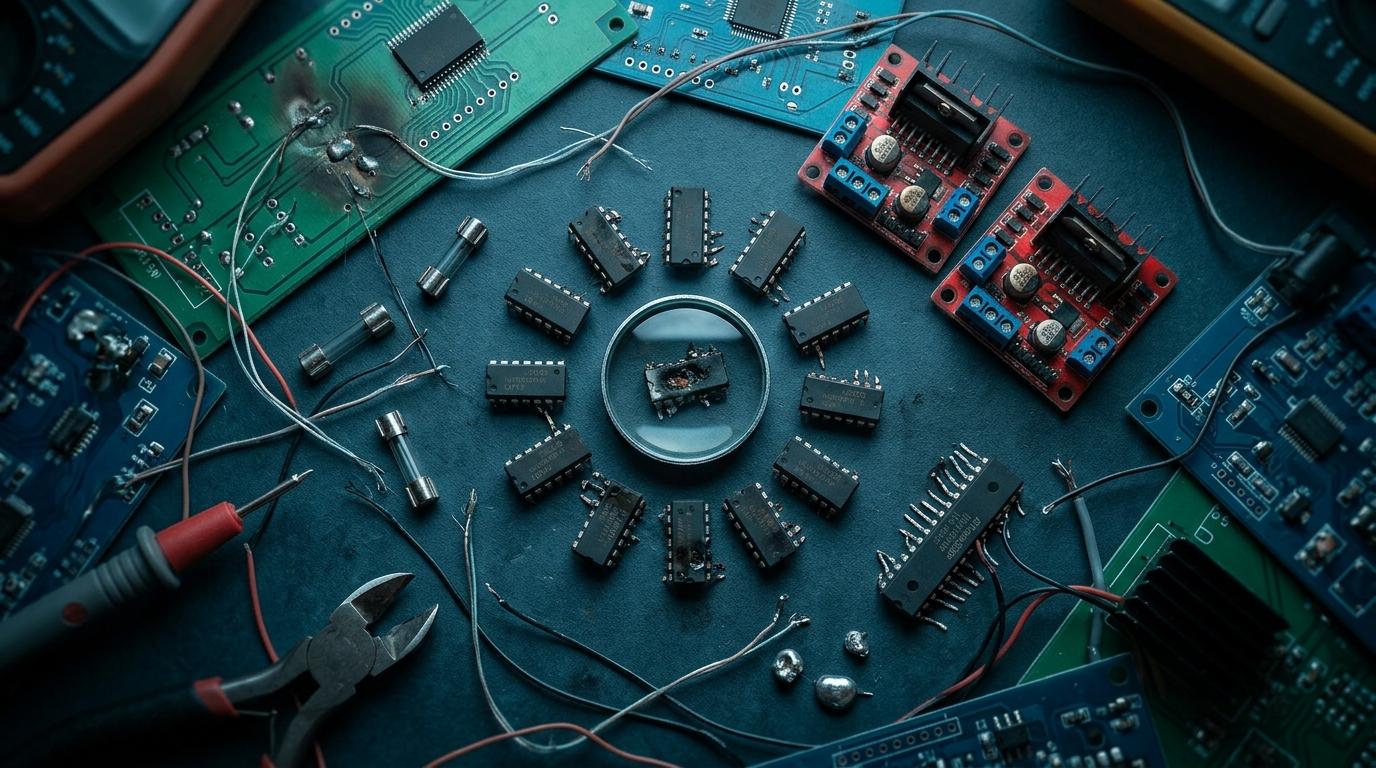
A stalled motor draws 5–10x its rated current. If your wheel robot hits a wall and the motors stall while PWM is still running, the driver sees a massive current spike. Add current limiting, stall detection, or at minimum watch your driver temperature.
Mistake 4: Wrong enable pin logic
The enable pins on the L293D aren't just on/off switches. They control speed via PWM. If you leave enable HIGH constantly and try to control direction with the input pins, you lose speed control and hammer the driver at full current. Use PWM on enable, not on the input pins.
The switch to L298N (and its own problems)
The L298N module looks like a step up: more current capacity, easier to mount. But it gets hot. Very hot. The voltage drop across the L298N is almost 2V per channel — on a 6V motor supply you're feeding 4V to your motor. If heat is your enemy, move to DRV8833 or TB6612FNG instead. Proper H-bridges with low resistance switching.
What actually fixed it
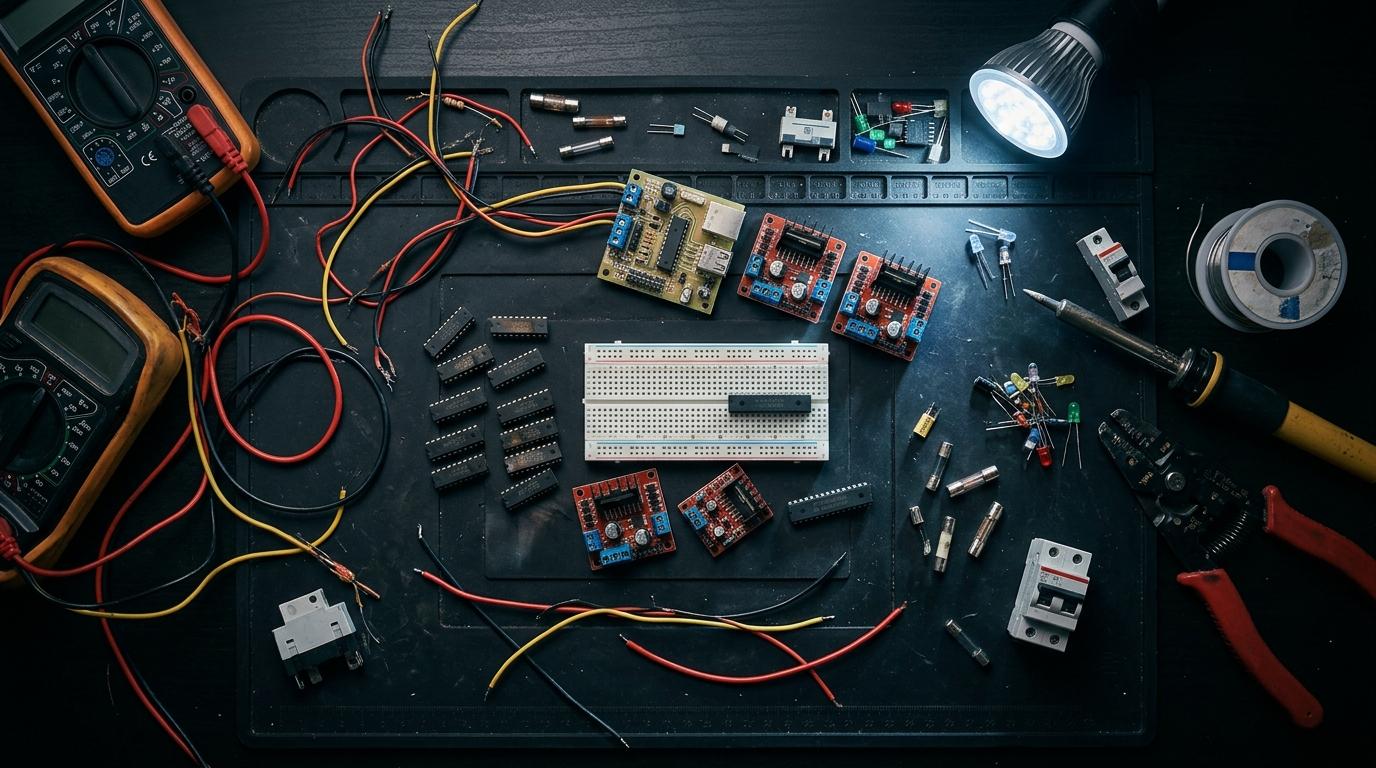
Separate power rails, decoupling capacitors on both supply rails (100uF electrolytic + 100nF ceramic), current-limited supply for testing, and a proper understanding of what each pin does before connecting anything. The datasheets are dense but reading them once saves components.
Need motor drivers or components for your build?
Find L293D, L298N, DRV8833 and other motor drivers from makers near you on RoboDIB.
More from the blog
RoboDIB
Solve these problems yourself
AI inventory, component map, 3D printing, and circuit design tools — all built for India's maker community.