Raspberry Pi vs Jetson Nano for Robotics — The Honest Comparison in 2025
Both run Linux. Both have GPIO. But for computer vision and edge AI, the difference is not subtle
If you're building a robot that needs computer vision, you'll inevitably hit this question: Raspberry Pi 4 or Jetson Nano? Both are Linux SBCs. Both have camera interfaces, GPIO, and large maker communities. But they perform completely differently on the workloads that matter for robotics.
The Core Difference: CPU vs GPU
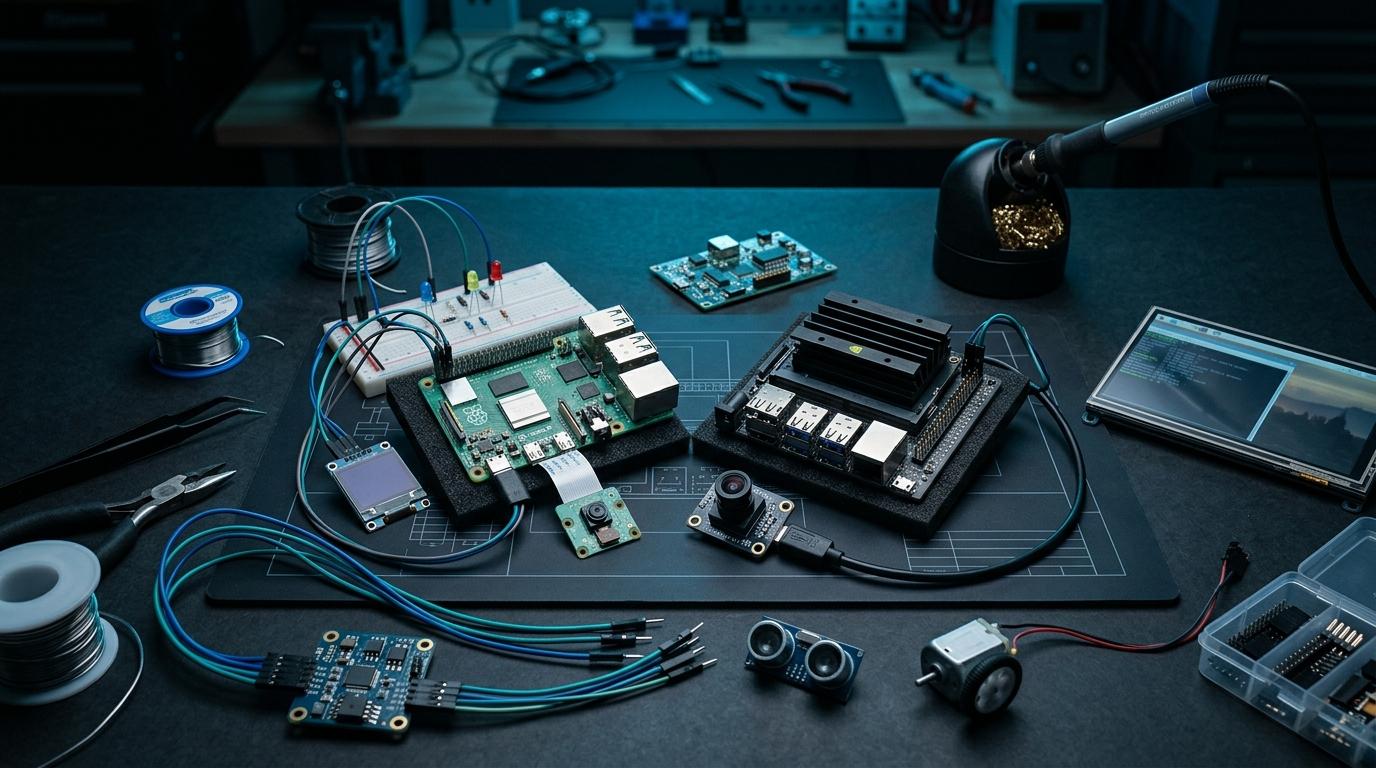
Raspberry Pi 4 has a 4-core ARM Cortex-A72 CPU running at 1.8GHz. It has no integrated GPU that's accessible for general compute. Running a YOLO object detection model on RPi4 gets you maybe 2–5 FPS in Python — usable for static scenes, not for real-time navigation.
Jetson Nano has a 128-core Maxwell GPU plus 4-core ARM Cortex-A57. NVIDIA TensorRT can run YOLO inference at 25–40 FPS on the same model. For robot navigation using object detection or depth estimation, this is the difference between functional and not functional.
When Raspberry Pi is the Right Choice
- Your robot logic is mostly serial comms, sensors, and actuation — no heavy ML
- You're running a web server or dashboard on the robot
- You need solid USB/Bluetooth/WiFi support and well-documented drivers
- Power budget matters (RPi4 draws 3–7W vs Jetson Nano's 5–10W at load)
- Your team has more Python/Linux experience with RPi ecosystem
When Jetson Nano is the Right Choice
- Real-time object detection, pose estimation, or depth estimation required
- You're running TensorFlow or PyTorch models onboard
- Your competition involves vision-based navigation
- You need to process camera frames at >10 FPS for robot decisions
The Hybrid Approach (Used in Competition Robots)
Many serious competition teams use Jetson Nano for vision inference and an Arduino/STM32 for real-time motor control. The Nano sends high-level commands (navigate left, pick up object) via serial to the microcontroller that handles PWM and encoder feedback at kHz rates. This separation is architecturally clean and works well.
Building a vision robot and need parts?
Find SBCs, camera modules, and motor controllers from makers on RoboDIB.
More from the blog
RoboDIB
Solve these problems yourself
AI inventory, component map, 3D printing, and circuit design tools — all built for India's maker community.