LiPo Batteries — What Every RC and Drone Hobbyist Needs to Know Before One Catches Fire
LiPo care isn't paranoia. It's what separates hobbyists who've been doing this for years from those who've had a very bad day
A LiPo (Lithium Polymer) battery is the most energy-dense thing most hobbyists will ever hold in their hands. Per kilogram, it stores more energy than most other battery chemistries. When that energy releases correctly, you get 10 minutes of flight or blistering RC acceleration. When it doesn't, you get a thermal runaway fire that's hard to put out.
This isn't meant to scare you off LiPo. Millions of people use them every day without incident. It's meant to make sure you're not the person who starts a garage fire.
Voltage, S-Count, and Cell Limits
Each LiPo cell has a working range of 3.0V (dead empty) to 4.2V (full charge). A 4S LiPo has 4 cells in series: nominal 14.8V, max 16.8V, storage 15.2V, minimum 12V. Never go below 3.5V per cell under load. Never charge above 4.2V per cell.
Charging Safely
- Always use a balance charger — it monitors individual cells
- Never charge at more than 1C (capacity in Ah). A 1300mAh pack charges at max 1.3A at 1C
- Never leave charging packs unattended
- Charge in a LiPo-safe bag or metal container
- Never charge a puffed or damaged pack
Storage Voltage is Real
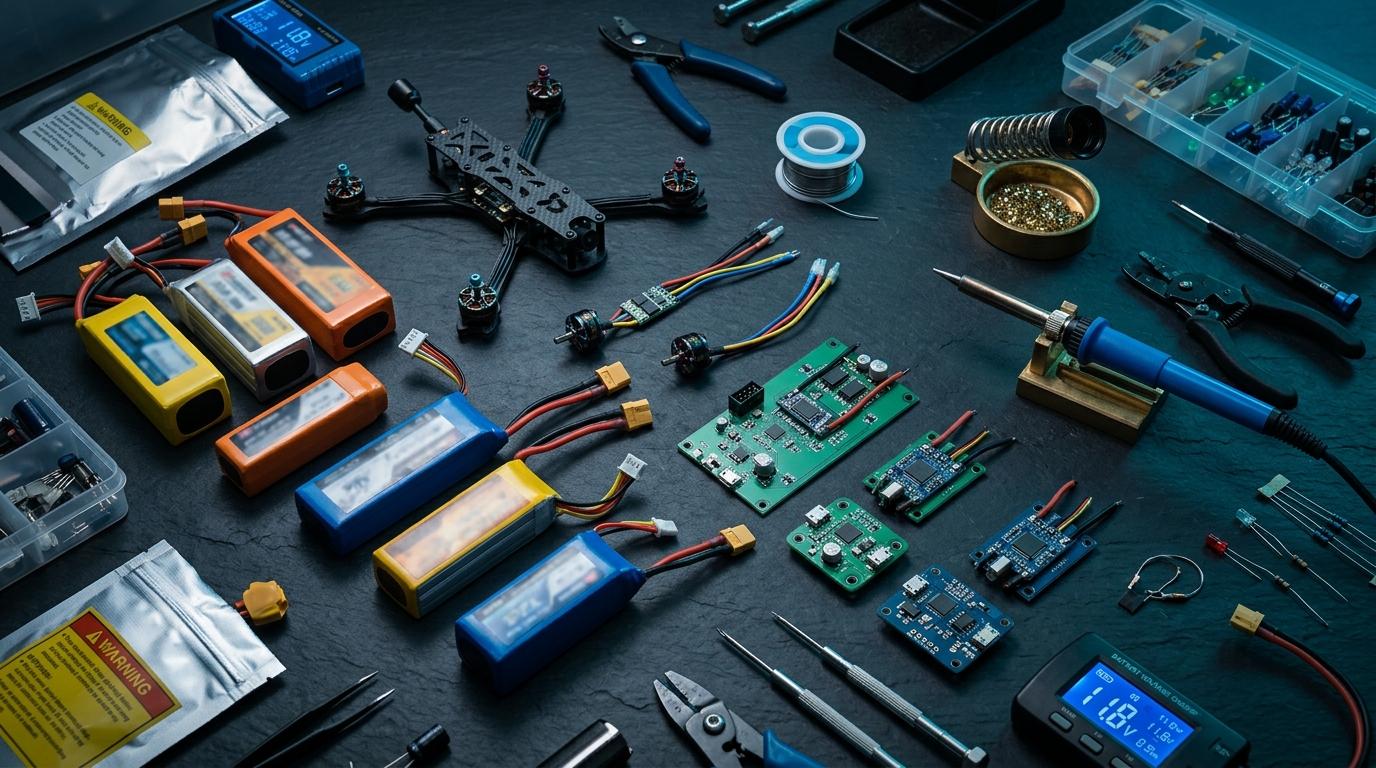
If you're not flying for more than a few days, discharge to storage voltage (3.8V per cell). Most chargers have a 'storage' mode. Leaving a pack fully charged accelerates cell degradation. Leaving it discharged below 3.0V kills cells permanently. Storage voltage is the sweet spot for longevity.
Signs a Pack Needs Retirement
- Puffing (cell swelling) — the pack is venting gas, this is a warning sign
- One cell consistently drops lower than others during discharge
- Capacity has dropped significantly vs original rating
- Pack gets hot quickly even at moderate discharge
Disposing of LiPo Properly
Discharge fully in a bucket of salt water over 24 hours, then wrap in paper and discard as electronics waste. Don't throw them in regular trash — they can puncture and catch fire in garbage trucks.
Need LiPo batteries or charging equipment?
Find batteries, balance chargers, and storage bags from local hobbyists.
More from the blog
RoboDIB
Solve these problems yourself
AI inventory, component map, 3D printing, and circuit design tools — all built for India's maker community.