Arduino vs ESP32 for Your Robotics Project — When to Use Which
They're not competitors — they solve different problems. But picking the wrong one wastes more time than you'd expect
The question comes up constantly in maker forums: 'Should I use Arduino or ESP32 for this?' And the frustrating answer is: it depends. But here's a framework that actually makes the decision easy.
What Arduino (Uno/Nano) Does Well
Arduino boards are simple, rugged, and have deterministic timing. No RTOS, no WiFi stack competing for cycles, no dual cores. For time-sensitive tasks — reading encoders, generating precise PWM, controlling steppers — this simplicity is a feature. Also: 5V I/O natively, which plays nicely with older sensors and displays.
What ESP32 Does Well
ESP32 is a dual-core 240MHz powerhouse with WiFi, Bluetooth, 4MB flash, and plenty of GPIO — for around ₹300–400 as a module. If your project needs connectivity, OTA updates, a web dashboard, MQTT, or just more raw compute, ESP32 makes sense. It runs FreeRTOS internally, which actually helps for multi-task projects.
The One Thing That Trips People Up
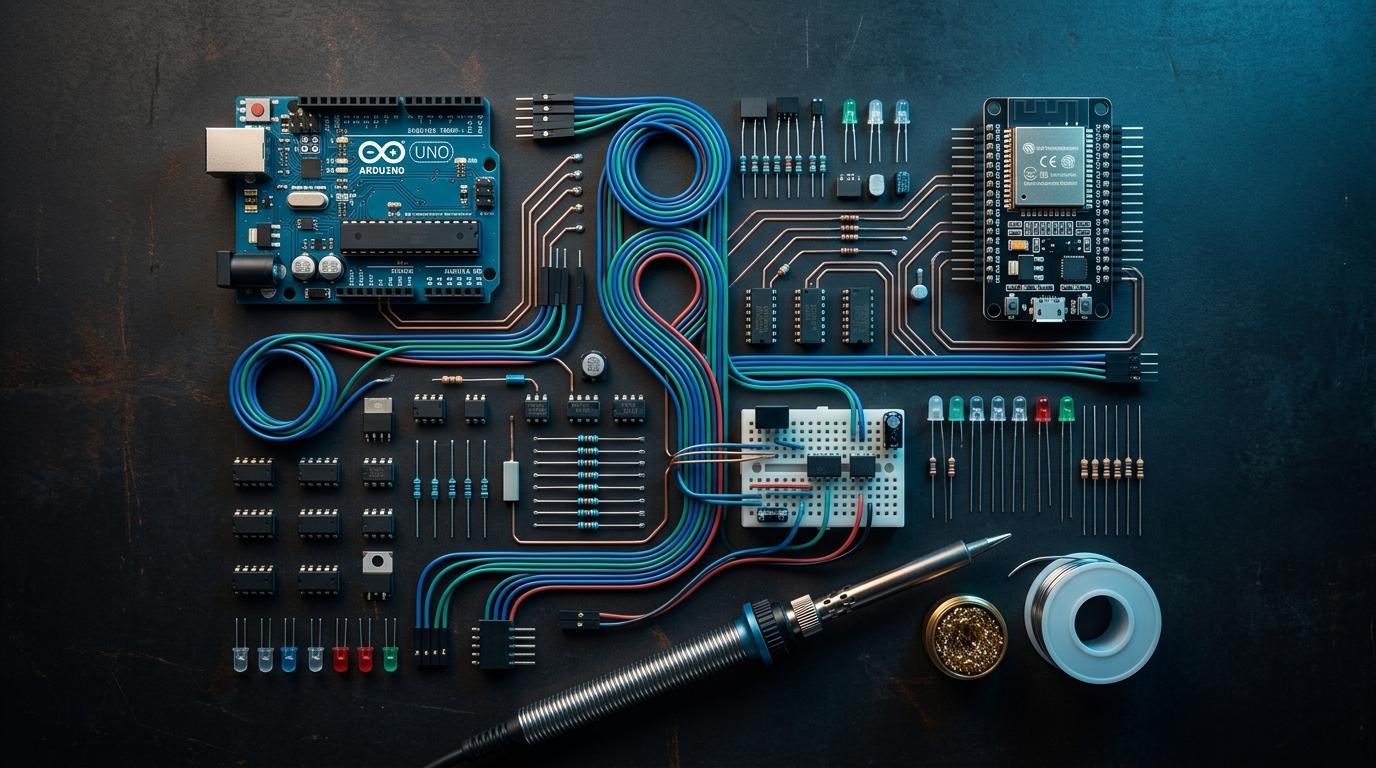
ESP32 I/O is 3.3V tolerant only. Feeding it 5V signals directly can damage GPIO pins. Arduino Uno is 5V. This matters when mixing sensors and modules. Many beginners learn this the expensive way.
Decision Framework
- Need WiFi/Bluetooth? → ESP32, no contest
- Controlling motors with tight timing? → Arduino (or use ESP32's MCPWM peripheral carefully)
- Battery-powered and need deep sleep? → ESP32 wins again
- Talking to a 5V display or sensor without level shifters? → Arduino easier
- Running multiple concurrent tasks? → ESP32 with FreeRTOS
- Teaching someone to code for the first time? → Arduino Uno, simpler IDE experience
The Hybrid Approach
Many experienced builders use both: an Arduino (or ATMega) handles real-time control (PWM, encoders, motor drivers), while an ESP32 handles connectivity and higher-level logic. They communicate via UART or I2C. This architecture is common in FPV flight controllers and robotic arms.
Building a robotics project and need parts?
Find Arduino boards, ESP32 modules, and sensors from local makers.
More from the blog
RoboDIB
Solve these problems yourself
AI inventory, component map, 3D printing, and circuit design tools — all built for India's maker community.